Turning three is an exciting milestone in your child’s development. As children transition from toddlerhood into the preschool years, they become more independent, curious and confident in their everyday abilities. Whether they’re climbing the playground, asking endless “why?” questions or proudly pouring their own drink, three-year-olds are constantly developing new skills through exploration and experience.
Understanding 3-year-old developmental milestones can help you recognise your child’s progress while remembering that every child develops at their own pace. Developmental milestones are a helpful guide, not a checklist that every child must achieve by a specific birthday. Some children may excel in language, while others show strengths in physical or social development, and all of these differences are a normal part of growing up.
In this guide, we’ll explore the typical developmental milestones for a 3-year-old, including physical, language, cognitive, social and emotional development. We’ll also share practical ways to support your child’s learning at home and explain how Montessori education encourages confidence, independence and a lifelong love of learning.
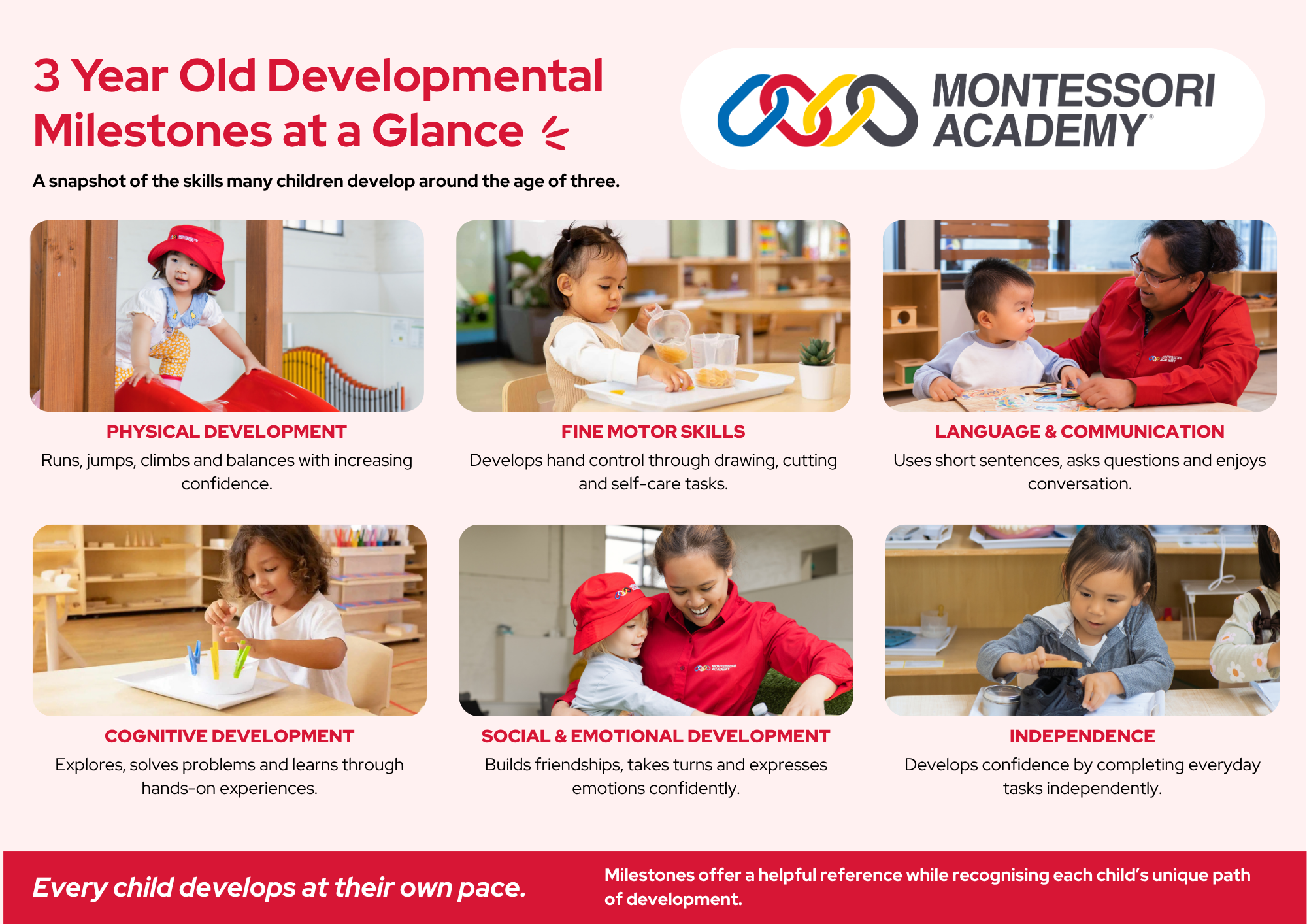
3-Year-Old Developmental Milestones at a Glance
By the age of three, many children are becoming increasingly confident in their movement, communication and independence. While every child’s development is unique, the table below highlights some of the common milestones parents may observe.
| Development Area | Typical Milestones at 3 Years |
|---|---|
| Physical | Runs confidently, jumps with both feet, climbs playground equipment and pedals a tricycle. |
| Fine Motor | Draws simple shapes, uses child-safe scissors, threads beads and begins dressing independently. |
| Language & Communication | Speaks in short sentences, asks questions and follows two-step instructions. |
| Cognitive | Sorts objects, completes simple puzzles and enjoys imaginative play. |
| Social & Emotional | Begins cooperative play, develops friendships and expresses emotions more clearly. |
| Independence | Helps with everyday tasks, washes hands, packs away toys and feeds themselves using cutlery. |
Physical Development
Physical development is one of the most noticeable changes during the preschool years. As children’s muscles become stronger and coordination improves, they gain the confidence to move more freely, explore their surroundings and participate in increasingly complex activities.
Physical development includes both gross motor skills, which involve large body movements, and fine motor skills, which focus on hand and finger control.
Gross Motor Milestones
Gross motor skills allow children to run, climb, balance and jump with increasing confidence. These movements support not only physical health but also spatial awareness, coordination and self-confidence.
By three years old, many children are beginning to:
- Run smoothly and change direction with confidence
- Jump forwards with both feet together
- Balance briefly on one foot
- Walk up and down stairs using alternating feet
- Kick and throw a ball with improved coordination
- Pedal a tricycle
- Climb playground equipment independently
Fine Motor Milestones
Fine motor development strengthens the small muscles in the hands and fingers that children use for everyday tasks such as dressing, eating and drawing.
Many three-year-olds are developing greater hand strength and coordination, allowing them to:
- Copy simple shapes, such as a circle
- Build towers using blocks
- Thread large beads
- Hold crayons with increasing control
- Use child-safe scissors with supervision
- Feed themselves using a fork and spoon
- Begin fastening simple clothing, such as large buttons or zip
How Montessori Supports Physical Development
At Montessori Academy, movement is viewed as an essential part of learning. Children strengthen gross and fine motor skills through purposeful activities
Everyday experiences such as carrying learning materials, preparing food, watering plants and caring for the classroom naturally develop coordination, balance and hand strength while fostering independence. These meaningful activities, coupled with outdoor play, also help children build concentration and confidence as they master real-life skills and nurture their physical wellbeing
Language and Communication Development
By the age of three, many children become enthusiastic communicators. Their vocabulary grows rapidly, conversations become more detailed, and they begin asking questions about the world around them. While every child’s communication skills develop at their own pace, this stage often marks a significant leap in language and confidence.
By three years old, many children can:
- Speak in short sentences using three to five words or more
- Follow simple two or three-step instructions
- Ask and answer simple questions
- Hold conversations with familiar adults
- Talk about recent experiences, favourite activities or familiar people
- Enjoy listening to stories and joining in with songs and rhymes
Some sounds may still be developing at this age, and it’s common for children to make grammatical mistakes as they experiment with language. These skills continue to improve through regular conversation, shared reading and meaningful interactions.
How Montessori Supports Language Development
Language is woven into every aspect of the Montessori classroom. Rather than teaching vocabulary in isolation, educators introduce new words naturally through hands-on experiences and purposeful conversations.
Whether children are preparing food, caring for plants or completing Practical Life activities, educators use rich, descriptive language to expand vocabulary and encourage communication. Stories, songs, classified cards and conversations throughout the day further support children’s language development.
Common Montessori language activities that support this include nomenclature cards, the Moveable alphabet, or sandpaper letters.
These experiences align with the Early Years Learning Framework (EYLF), which recognises communication as a key outcome of early childhood education.
Cognitive Development
Three-year-olds are naturally curious. They enjoy exploring how things work, solving simple problems and using their imagination to make sense of the world around them. As cognitive skills develop, children become more confident making decisions, remembering routines and experimenting with new ideas.
At this age, many children are beginning to:
- Sort objects by colour, shape or size
- Complete simple puzzles
- Count small groups of objects
- Match similar objects
- Recognise familiar colours
- Engage in imaginative or pretend play
- Solve simple everyday problems independently
Rather than memorising information, children learn best by exploring, repeating activities and discovering solutions independently.
How Montessori Supports Cognitive Development
Montessori materials are designed to encourage exploration and independent thinking. Many activities include a built-in control of error, allowing children to recognise and correct mistakes without relying on an adult.
As children compare, sort, sequence and classify materials, they develop concentration, logical thinking and problem-solving skills. They also learn to persevere through challenges, building confidence alongside cognitive development.
These experiences contribute to the EYLF Learning Outcomes, supporting children to become confident and involved learners.
Social and Emotional Development
Social and emotional development go hand in hand during the preschool years. As children gain confidence communicating and expressing themselves, they also begin building friendships, developing empathy and learning how to manage their emotions.
While sharing, turn-taking and emotional regulation continue to develop over time, many three-year-olds enjoy participating in cooperative play and interacting with other children.
Many three-year-olds are learning to:
- Play cooperatively with other children
- Begin taking turns during play
- Develop friendships
- Express a wider range of emotions
- Show empathy towards others
- Enjoy imaginative role play
- Follow familiar routines and expectations
It’s important to remember that strong emotions are still a normal part of development. Children continue learning how to manage disappointment, frustration and excitement with support from trusted adults.
How Montessori Supports Social and Emotional Development
Respect for self, others and the environment is central to Montessori education.
Through Grace and Courtesy lessons, children learn everyday social skills such as greeting others politely, waiting patiently, asking for help . Mixed-age classrooms also provide opportunities to learn from peers, develop empathy and build meaningful relationships.
By encouraging children to make choices, solve problems and complete tasks independently, Montessori environments also nurture confidence, resilience and a positive sense of self.
Building Independence Through Everyday Life
One of the biggest developmental milestones at three years old is a growing desire to do things independently. Children often want to dress themselves, help prepare meals, tidy up after play and take part in everyday family routines.
Encouraging independence helps children build confidence while developing important life skills such as problem-solving, concentration and responsibility. Rather than rushing to complete tasks for your child, offering time, encouragement and age-appropriate opportunities to practise can make a significant difference.
Many children are becoming more confident completing everyday tasks, including:
- Washing and drying their hands with minimal assistance
- Feeding themselves using cutlery
- Drinking from an open cup
- Putting on simple items of clothing
- Packing away toys after play
- Helping prepare simple snacks
- Following familiar daily routines
In Montessori education, these everyday tasks are known as Practical Life activities. They help children develop independence, coordination and confidence while fostering a sense of contribution within the home and classroom.
If you’re looking for simple ways to encourage independence at home, explore our guide to Age-Appropriate Family Work.
Simple Activities to Support Your 3 Year Old’s Development
Children learn best through meaningful, hands-on experiences. Everyday activities can provide valuable opportunities to strengthen physical, cognitive, language and social skills while making learning enjoyable.
Here are a few simple ideas to try at home:
| Development Area | Activities |
|---|---|
| Physical | Nature walks, playground visits, dancing, balancing games and gardening |
| Fine Motor | Pouring water, threading large beads, preparing fruit, drawing and using child-safe tongs |
| Language | Reading together, storytelling, singing songs and talking about your day |
| Cognitive | Sorting laundry, simple puzzles, matching games and cooking together |
| Social & Emotional | Role play, board games, taking turns and talking about feelings |
Rather than focusing on achieving milestones quickly, aim to provide regular opportunities for your child to explore, practise and enjoy learning through everyday experiences.
How Montessori Academy Supports 3-Year-Old Development
At Montessori Academy, we believe every child is naturally curious and capable of learning when given the right environment.
Our educators create carefully prepared learning spaces where children develop physical, cognitive, language, social and emotional skills through purposeful, hands-on experiences. From Practical Life activities that build independence to Sensorial materials that encourage critical thinking, every experience is designed to support children’s natural development while fostering confidence and a love of learning.
Learn more about our Montessori Curriculum and how it supports children’s development through every stage of early childhood.
Our programs are also guided by the Early Years Learning Framework (EYLF), helping children build the knowledge, confidence and skills they need to thrive both in early childhood and beyond.
If your child is approaching or has recently turned three, our Toddler Program provides a nurturing environment where they can continue developing independence, resilience and a lifelong love of learning.
You can also explore our guide to 1 Year Old Developmental Milestones to learn how development begins during your child’s earliest years.
Download Your Free 3 Year Old Developmental Milestones Snapshot
Looking for a simple resource to help you understand your child’s development? Our printable 3 Year Old Developmental Milestones Snapshot highlights some of the skills children may develop around the age of three, while recognising that every child’s developmental journey is unique.
Use it as a helpful reference to observe emerging skills, celebrate new achievements and support your child’s development at their own pace.
Download your free 3 Year Old Developmental Milestones Snapshot (PDF).
Frequently Asked Questions
What are the developmental milestones for a 3 year old?
Typical 3-year-old developmental milestones include running, jumping, climbing, speaking in short sentences, following simple instructions, developing friendships, completing simple self-care tasks and becoming increasingly independent in everyday routines. Remember that every child develops at their own pace, so milestones should be viewed as a guide rather than a checklist.
What language skills should a 3-year-old have?
By the age of three, many children can speak in short sentences, ask and answer simple questions, follow two or three-step instructions, and enjoy conversations with familiar adults. They also begin using language to describe experiences, express emotions and ask questions about the world around them. Vocabulary continues to expand rapidly throughout the preschool years.
What are the gross and fine motor milestones for a 3-year-old?
Many three-year-olds can run confidently, jump with both feet together, climb playground equipment and pedal a tricycle. Fine motor skills are also becoming more refined, with many children able to draw simple shapes, use child-safe scissors with supervision, thread large beads and feed themselves using cutlery. These skills continue to develop through regular opportunities for movement and hands-on activities.
How can I support my 3-year old’s development at home?
The best way to support your child’s development is through meaningful everyday experiences. Reading together, talking throughout the day, encouraging outdoor play, completing puzzles, preparing simple meals together and involving your child in age-appropriate household tasks all help build physical, language, cognitive and social skills. Providing opportunities for independence while following your child’s interests also encourages confidence and a lifelong love of learning.
Supporting Every Step of Your Child’s Journey
Watching your three-year-old grow is an exciting experience filled with new achievements, growing independence and meaningful discoveries. From mastering everyday tasks to building friendships and developing confidence, every milestone is an important step in your child’s unique learning journey. While 3-year-old developmental milestones provide a helpful guide, it’s important to remember that every child develops at their own pace, with their own strengths, interests and personality.
By creating opportunities for movement, conversation, exploration and real-life learning, you can support your child’s development in ways that feel both meaningful and enjoyable. Whether they’re helping prepare a meal, exploring nature, solving a puzzle or sharing a story, these everyday experiences lay the foundation for future learning, resilience and independence.
At Montessori Academy, we’re passionate about supporting every stage of childhood through purposeful, hands-on learning experiences that nurture curiosity, confidence and a lifelong love of learning. Guided by the Montessori philosophy and the Early Years Learning Framework, our educators create prepared environments where children are empowered to explore, make choices and develop at their own pace.
Whether your child is just beginning to develop new skills or preparing for the transition to preschool, we’re here to partner with your family every step of the way, celebrating each milestone and helping your child build the confidence and capabilities to thrive both now and into the future.