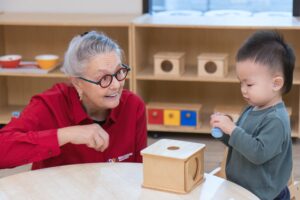
So, how much sleep do children need? In Australia, the recommended sleep for young children ranges from 14–17 hours a day for newborns down to 10–13 hours for preschoolers, including naps.
At Montessori Academy, we see every day how a well-rested child engages with their daily routine. This guide pairs trusted Australian health guidance with what our qualified educators observe every day across our centres.
Recommended sleep by age
The recommended hours of sleep by age below come from the Australian Department of Health’s recommendations, as summarised in the Sydney Children’s Hospitals Network (SCHN) sleep recommendations. All totals are based on a 24-hour day and include naps.
| Age group | Recommended amount of sleep (per 24 hours) | What it often looks like |
| Newborns (0–3 months) | 14–17 hours | Short bursts of 2–3 hours, waking for feeds |
| Babies (4–11 months) | 12–16 hours | Around three naps at 3–6 months, decreasing to two at 6–9 months and often one by 12 months |
| Toddlers (1–2 years) | 11–14 hours | About 10–12 hours overnight plus one or two naps of 1–2.5 hours |
| Preschoolers (3–6 years) | 10–13 hours | Mostly overnight sleep; some children still need a daytime nap |
Think of this child sleep chart by age as a guide rather than a target. Every child is different, and SCHN notes your child may need a little more or less sleep.
Importance of sleep for toddlers and preschoolers
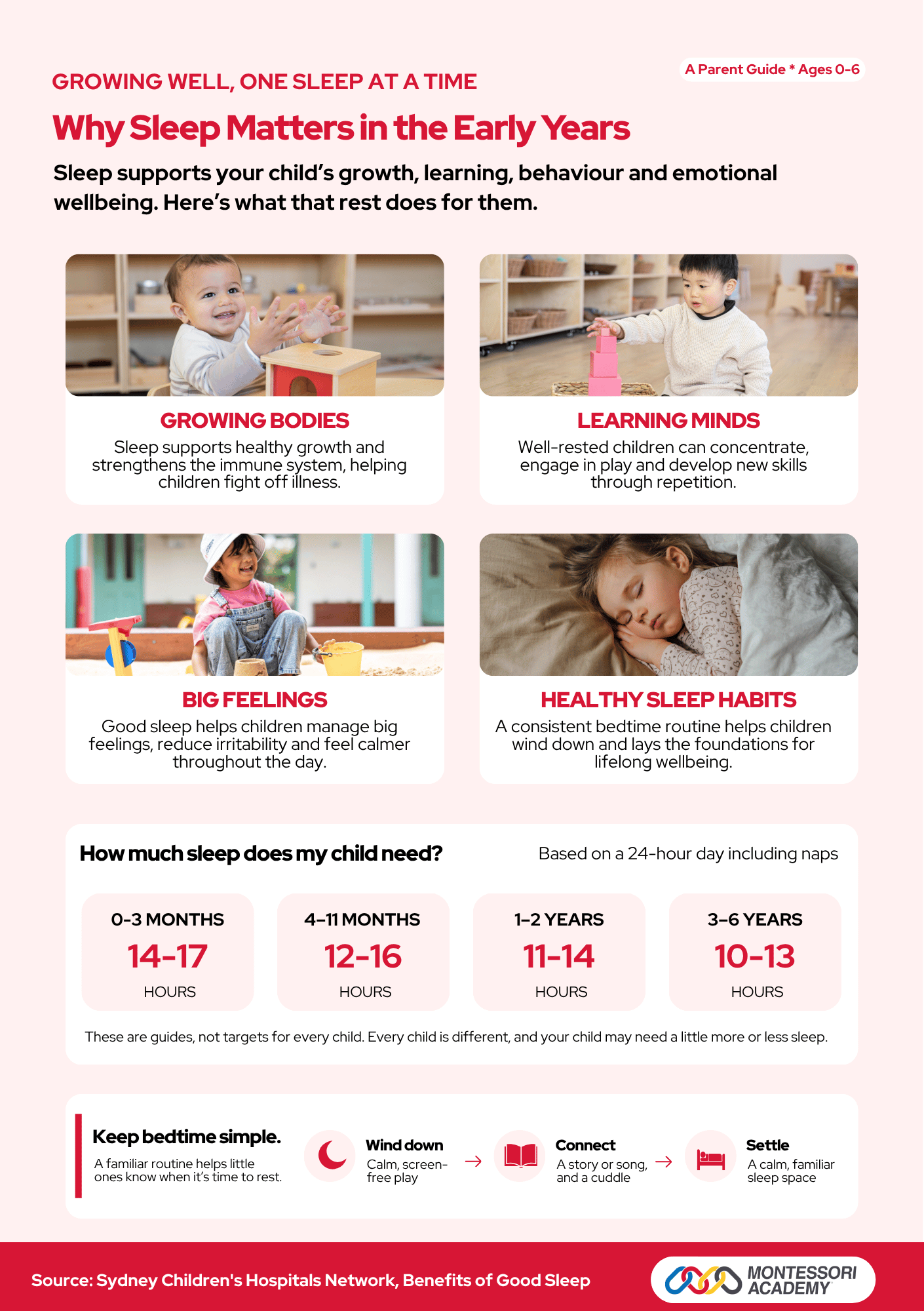
Sleep plays a vital role in early childhood. According to SCHN, good sleep supports a child’s body, brain and emotions. Sleep and child development go hand in hand.
Sleep affects growth
In children, growth hormones are released mainly during sleep, as researchers at the US National Institute of Environmental Health Sciences explain. SCHN adds that sleep strengthens the immune system, helping children fight off illness.
Rest affects learning
Rested children concentrate more easily and engage fully in play. In a Montessori classroom, a child who has slept well is more likely to choose an activity, repeat it and see it through, which is how they build new skills and reach their developmental milestones.
Sleep deprivation does the opposite, making it harder for children to focus, remember and manage their feelings.
Good sleep habits build healthy routines for life
The sleep habits children form now lay the groundwork for life, and healthy sleep in childhood supports positive mental health later on. A consistent sleep routine also helps a child’s nervous system learn when it’s time to wind down.
How tiredness can show up: signs to look out for
Some tired signs are obvious, like yawning or eye rubbing. Others are easy to mistake for “naughty” behaviour. SCHN’s list of tired signs includes:
- yawning, rubbing eyes or staring blankly
- sucking fingers or hands
- becoming irritable, clingy or upset
- moving more slowly, or with jerky movements
- fussy eating
- losing interest in toys and activities
When young children miss a nap or go to bed too late, they can become overtired. Overtiredness often looks surprising: a sudden burst of energy, tantrums, big reactions to small changes, or fighting sleep even when they’re exhausted.
In our classrooms, educators stay attuned to these cues as part of caring for each child, so tiredness is noticed whenever it appears. At home, noting when the signs appear over a week can show when your child’s sleep schedule needs a small adjustment.
When do toddlers stop their nap?
Most toddlers stop to one nap between 12 and 18 months, and most stop napping altogether between three and five. According to SCHN’s toddler guidance, the daytime nap usually stops around age three, although some preschoolers occasionally still need one.
| Age | Typical sleep pattern |
| 12–18 months | Two naps become one, often after lunch |
| 18 months–3 years | One daytime nap of 1–2.5 hours |
| 3–6 years | Nap shortens, becomes occasional, then stops |
Signs your toddler may be ready to stop their day nap
- They lie quietly at nap time but don’t fall asleep, day after day, without being upset.
- Bedtime keeps sliding later on days they do nap.
- They cope well through the late afternoon without a nap.
- Night sleep is long and settled.
Watch for a few weeks before deciding. A short “nap strike” around age two and a half often passes, as Acibadem’s paediatric team notes, and a toddler who falls asleep in the car at 4 pm probably still needs their nap.
Making the transition gentler
Think of the nap as a dimmer rather than a switch. Swap it for quiet time at the same time each day, bring bedtime a little earlier, and keep the morning wake time steady.
Montessori tips to support calming sleep routines at home
A Montessori approach to sleep shares principles that health guidelines recommend including predictability, a calm environment and respect for growing independence.
Keep consistent sleep and wake times
SCHN recommends keeping bedtime and wake-up times roughly the same every day, weekends included, to set your child’s body clock. Montessori classrooms rely on a similar and predictable rhythm to help children feel secure.
Create a calm wind-down with the same steps each night
A short, predictable bedtime routine signals that sleep is coming dinner, bath, teeth, pyjamas, a story and a cuddle. In the Montessori spirit, let your child take the lead in these steps they can manage, like choosing pyjamas or picking tonight’s book. Small choices within a clear structure reduce bedtime battles.
Put screens away well before bed
SCHN advises switching off screens at least one hour before bedtime, because their light interferes with melatonin, the hormone that helps your child feel sleepy. Swap them for books or quiet puzzles.
Prepare the sleep environment
Montessori values the prepared environment, and the bedroom is no exception. Keep it quiet, dark and comfortable (SCHN suggests 20–22°C), keep play and screens in other rooms, and choose a dim, warm night light if your child wants one.
Get outside during the day
Daylight and active play help set the body clock, making it easier for children to wind down at night. Morning time outdoors is a simple habit that supports healthy sleep patterns.
Still struggling after a few weeks? SCHN has information on sleep training approaches, and your child and family health nurse can help.
Preparing your child for nap time at childcare
Rest time at childcare is a new routine for many children, and most settle into it quickly. A few simple steps at home can help it feel familiar from the start.
- Share your child’s routine. Tell educators when your child usually sleeps and what helps them settle.
- Pack familiar comforts. A comfort item from home can help (check your centre’s safe sleep guidelines first).
- Keep weekends similar. Our rest time usually starts around 12 pm, so offering a nap or quiet time then on weekends keeps your child’s body clock steady.
- Talk about rest time positively. Simple words like “after lunch, everyone has a quiet rest” help your child know what to expect.
- Keep talking with educators. If your child is sleeping too long at the centre or not resting at all, let us know so we can work together.
How Montessori Academy keeps rest time safe and calm
Every Australian early learning service must have sleep and rest policies that meet the national regulations and provide for each child’s individual needs (ACECQA). Children who don’t need to sleep are offered quiet activities instead.
At Montessori Academy, our approach includes:
- A predictable daily rhythm. Across our Infant, Toddler and Preschool programs, sleep or rest time runs from around 12 pm to 2 pm, straight after lunch.
- Sleep, rest or quiet activity. Children who no longer nap still have a calm, restful option.
- Individual schedules for our youngest children. In the Infant Program, each child’s own sleeping schedule can be accommodated.
- Partnership with families. We respect each family’s preferences and invite them to share their child’s routines.
- Safe sleep in line with Red Nose Australia. We follow the national regulations and Red Nose safe sleep recommendations: babies sleep on their back in cots with firm, flat mattresses that meet Australian standards; cots are free of pillows, quilts, soft toys, bumpers and loose bedding; faces and heads stay uncovered, with hats and necklaces removed; and children who can climb out of a cot move to a floor mat. Bassinets are not used.
- Physical sleep checks every 10 minutes. Educators physically check every sleeping child every 10 minutes, with cot room monitors providing continuous visual oversight (Our Commitment to Children’s Safety).
- Active supervision. Audited supervision plans keep children within sight or hearing of multiple educators, and no child is ever alone with one adult out of sight.
We protect rest time so every child can relax. We schedule centre tours outside rest periods, so children can wind down and fall asleep in a calm, quiet room. When you book, we’ll find a time that lets you see our classrooms at their liveliest.
FAQs
How many naps do toddlers need?
Most toddlers need one nap a day. Younger toddlers may still take two naps until somewhere between 12 and 18 months, when they usually transition to a single nap of 1–2.5 hours (SCHN).
What is the hardest age for baby sleep?
Many families find the second half of the first year challenging. SCHN notes that milestones like crawling and teething can disrupt sleep from around six to nine months.
Is there a 2-year-old sleep regression?
Many parents notice their two-year-old suddenly fighting sleep. Growing independence, new skills, big feelings and changes like moving to a big bed can all play a part. It’s usually temporary, and a consistent bedtime routine is the best way through it.
What happens if a toddler doesn’t sleep enough?
A toddler who is short on sleep may find it harder to concentrate, follow instructions and manage their emotions, and may get sick more often (SCHN). Overtired toddlers can also seem hyperactive rather than sleepy.
Should I wake my toddler from a nap?
If a long or late nap is regularly pushing bedtime later, gently waking your toddler can help protect their night sleep. Every child is different, so watch how they cope in the late afternoon and at bedtime, and adjust from there.
Can I ask my childcare centre to stop my child’s nap?
Yes. Under the National Quality Standard, services work with families to agree on each child’s sleep and rest routine (ACECQA). If this is you, know that you’re not alone: a University of Queensland study of 750 parents found 79% no longer wanted their preschooler to sleep at childcare.