child safety at Montessori academy
Child Safety Always Comes First
At Montessori Academy, child safety is our highest priority and embedded in every decision, policy, and practice across all our services. Our seven pillar safety system sets the benchmark for child protection in Australia.
The Best Interests of Every Child, at the Centre of Every Decision.
At Montessori Academy, we are committed to providing safe, inclusive and nurturing environments where every child feels known, valued, respected and protected.
We uphold the National Principles for Child Safe Organisations and implement the Child Safe Standards to strengthen our ability to prevent harm, identify risks and respond swiftly and appropriately to concerns.
Child protection is our highest obligation. Every team member undergoes comprehensive pre-employment screening and ongoing training to ensure they have the knowledge, skills and confidence to maintain safe and supportive environments for children.
Through strong protective practices, active oversight, exceptional education and continuous improvement, we embed child safety into every aspect of our organisation. Every decision we make is guided by our responsibility to protect children, uphold the highest standards of quality and empower every child to thrive.
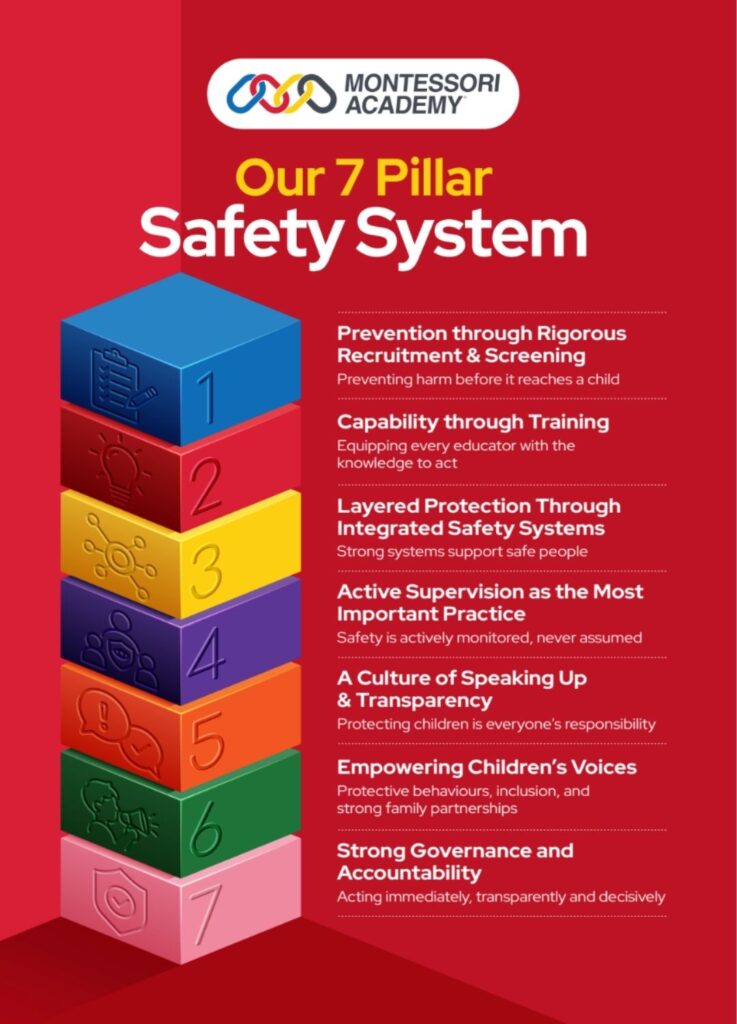
Seven Pillars of Child Safety
Our Seven Pillars of Safety provide the foundation for Montessori Academy’s organisation-wide approach to protecting children. Together, they bring our child safety commitment to life through rigorous recruitment, comprehensive educator training, active supervision, layered safeguards, a strong speak-up culture, accountable governance and the empowerment of children’s voices. Each pillar works together to prevent harm, strengthen everyday practice and ensure child safety is considered in every environment, interaction and decision.
Child Safety always comes first. Every decision. Every action. Every day.
Seven Pillars of
Child Safety
Our approach to child safety is built on seven core pillars, working together to provide strong, layered protection for every child in our care. Click each pillar to learn more.
Preventing harm before it reaches a child
Preventing harm before it reaches a child
Robust recruitment and vetting processes ensure all staff are suitable to work with children. From WWCC verification to psychometric testing for leaders, we leave nothing to chance.
🆚 National Regulations vs Our Difference
| National Regulation | Montessori Academy Goes Further |
|---|---|
| WWCC required before commencing work with children | Compliance Passport monitors WWCC status in real-time, 24/7 — instant alert if any clearance lapses or changes ★ Industry First |
| National police check required for approved providers | National police checks for all new permanent staff, plus psychometric testing for all leadership roles ↑ Exceeds |
| Reference checks as part of fit and proper person assessment | Fraud-detection platform verifies all references for authenticity — detecting fraudulent references before appointment ↑ Exceeds |
| Agency and casual staff permitted without additional vetting requirements | Minimised agency reliance — strong internal casual pool, all verified via Compliance Passport and performance-rated ↑ Exceeds |
| Contractor access not specifically mandated beyond general supervision | Contractor screening protocols and supervised escorted access at all centres at all times ↑ Exceeds |
Capability Through Training
Equipping every educator with the knowledge to act
All educators complete Mandatory Child Protection Training and are trained as Mandatory Reporters. Our comprehensive training framework goes far beyond the minimum requirements.
🆚 National Regulations vs Our Difference
| National Regulation | Montessori Academy Goes Further |
|---|---|
| Mandatory child protection training required for all nominated supervisors, staff and volunteers | 100% of staff hold current First Aid, CPR & Child Protection qualifications — fully funded by MA ↑ Exceeds |
| National child safety training modules required; refresher every 2 years | Structured end-to-end training framework from induction through to ongoing professional development ↑ Exceeds |
| Staff must be advised of child protection laws and their obligations | Dedicated team of Montessori Trainers and Quality and Safety Managers delivering regular face-to-face coaching, mentoring and professional development across our centres ★ Industry First |
| Mandatory reporting obligation under state child protection legislation | Mandatory reporting responsibilities are regularly reinforced through ongoing training, policy updates and leadership communication, guided by our See Something, Stop It, Say Something approach. ↑ Exceeds |
Layered Protection Through Integrated Safety Systems
Strong systems support safe people
24/7 CCTV with AI-powered Intelligent Safety Alerts at select locations, secure entry systems, and LifeVac choking response devices create multiple layers of physical protection at every centre.
🆚 National Regulations vs Our Difference
| National Regulation | Montessori Academy Goes Further |
|---|---|
| CCTV not mandated | 20 years of CCTV coverage at all centres with AI-powered Intelligent Safety Alerts at select locations ★ Industry First |
| Basic access control | Secure entry systems with approved access cards for all staff and families ↑ Exceeds |
| Visitor sign-in required | Mandatory sign-in, ID verification, and escorted access at all times ↑ Exceeds |
| First aid equipment required | First Aid equipment as well as LifeVac choking response devices onsite at every centre ↑ Exceeds |
| Digital technology policy required including rules on device use by staff and children | Strict technology policy: personal devices prohibited while working with children — enforced across all centres ↑ Exceeds |
Active Supervision as the Most Important Practice
Safety is actively monitored, never assumed
Our no-unsupervised-contact policy ensures no child is ever alone with one adult out of sight of others. Audited supervision plans are enforced across every centre.
🆚 National Regulations vs Our Difference
| National Regulation | Montessori Academy Goes Further |
|---|---|
| Active supervision required | Detailed, audited supervision plans — children always within sight and hearing of multiple educators ↑ Exceeds |
| Educator-to-child ratios mandated (e.g. 1:4 under 2s; 1:5 for 2–3 year olds; 1:10 for 3–5 year olds) | Educator-to-child ratios are carefully monitored throughout the day to ensure they meet or exceed regulatory requirements at all times, supporting active supervision, responsive care and safer learning environments. |
| Safe sleep policies and procedures required; physical sleep checks mandated | Staff physically check on sleeping children every 10 minutes PLUS Cot Room Monitors providing continuous visual oversight ↑ Exceeds |
| No specific policy on adult-child contact | Strict no-unsupervised-contact policy — no child ever alone with one adult out of sight ★ Industry First |
| Premises must be designed to facilitate supervision of children | Purpose-built and purposefully prepared Montessori environments are designed to support clear lines of sight, effective supervision and safe movement throughout the day, with comprehensive safety checks completed before children arrive each morning. ↑ Exceeds |
A Culture of Speaking-up & Transparency
Protecting children is everyone’s responsibility
An open reporting culture for staff and families, with clear escalation pathways and immediate investigation procedures. See Something, Stop It, Say Something.
🆚 National Regulations vs Our Difference
| National Regulation | Montessori Academy Goes Further |
|---|---|
| Mandatory reporting obligations — all educators legally required to report suspected abuse or neglect | Open reporting culture actively promoted at all levels — a cultural expectation embedded in induction, not just a legal obligation. See Something, Stop It, Say Something. ↑ Exceeds |
| Regulatory authority must be notified within 24 hours of any physical or sexual abuse allegation | All serious incidents reported within 24 hours plus clear escalation pathways with immediate investigation, regulatory notification, and family communication — no delays ↑ Exceeds |
| Families must be notified of incidents, injury, trauma or illness involving their child | Active family engagement with policies and safety practices — families are partners in child safety, not passive recipients ↑ Exceeds |
| No specific regulatory requirement for a speak-up or safety culture beyond compliance obligations | Great Place to Work™ Certified — an independently verified culture of safety and trust embedded organisation-wide ★ Industry First |
| Child safety explicitly named in NQS Quality Area 2 — staff must identify and respond to children at risk | Child safety is a standing agenda item in all team and leadership meetings — driving continuous improvement, not just compliance ★ Industry First |
Empowering Children’s Voices
Protective behaviours, inclusion and family partnerships
Children are empowered to speak up, understand their rights, and participate in their own safety. Parent sessions, community engagement, and the Montessori approach to child voice.
🆚 National Regulations vs Our Difference
| National Regulation | Montessori Academy Goes Further |
|---|---|
| Children's rights acknowledged under the UNCRC | Dedicated 'Empowering Children's Voices' curriculum integrated into Montessori pedagogy — children's rights taught daily ↑ Exceeds |
| Family communication required for significant incidents and general service information | Daily family communication and regular child safety and protective behaviours resources help keep families informed, connected and empowered. ↑ Exceeds |
| No specific regulatory requirement for child voice or participation in safety decisions | Children actively participate in decisions that affect them — voices heard, respected, and valued as part of daily practice ↑ Exceeds |
| Community engagement encouraged under NQS but not mandated under National Regulations | Partnership with national and local community organisations for holistic, evidence-based child protection ↑ Exceeds |
| No specific requirement for a protective behaviours curriculum under National Regulations | Protective behaviours, body autonomy and age-appropriate consent education are embedded into our program from the earliest years, helping children understand their rights, recognise unsafe situations and feel confident using their voice ↑ Exceeds |
Strong Governance and Accountability
Acting immediately, transparently, decisively
Aligned with National Principles for Child Safe Organisations and all regulations. Triple ISO Certification adds a layer of independent international auditing unique to Montessori Academy.
🆚 National Regulations vs Our Difference
| National Regulation | Montessori Academy Goes Further |
|---|---|
| NQS compliance required with quality assessment and rating against 7 quality areas | NQS compliant plus triple ISO Certification (9001, 14001, 45001) — the only childcare provider in Australia to achieve all three simultaneously ★ Industry First |
| Annual quality improvement plan review required | Daily and weekly compliance checks, monthly audits and risk assessments at every centre — far exceeding annual requirements ↑ Exceeds |
| No specific requirement for a dedicated child safety officer at centre level | Child Safety Officer in every single centre — dedicated daily accountability and proactive safety culture at the frontline ↑ Exceeds |
| Governance must support a quality, child safe service | Low Quality & Safety Manager-to-centre ratio with proactive compliance oversight and an industry-leading governance structure ↑ Exceeds |
| Alignment with National Principles for Child Safe Organisations required | Alignment with National Principles AND NSW Child Safe Standards — exceeding NQS governance requirements ↑ Exceeds |
Strengthensing Pillar 6: Empowering Children's Voices with Safe4Kids Protective Education
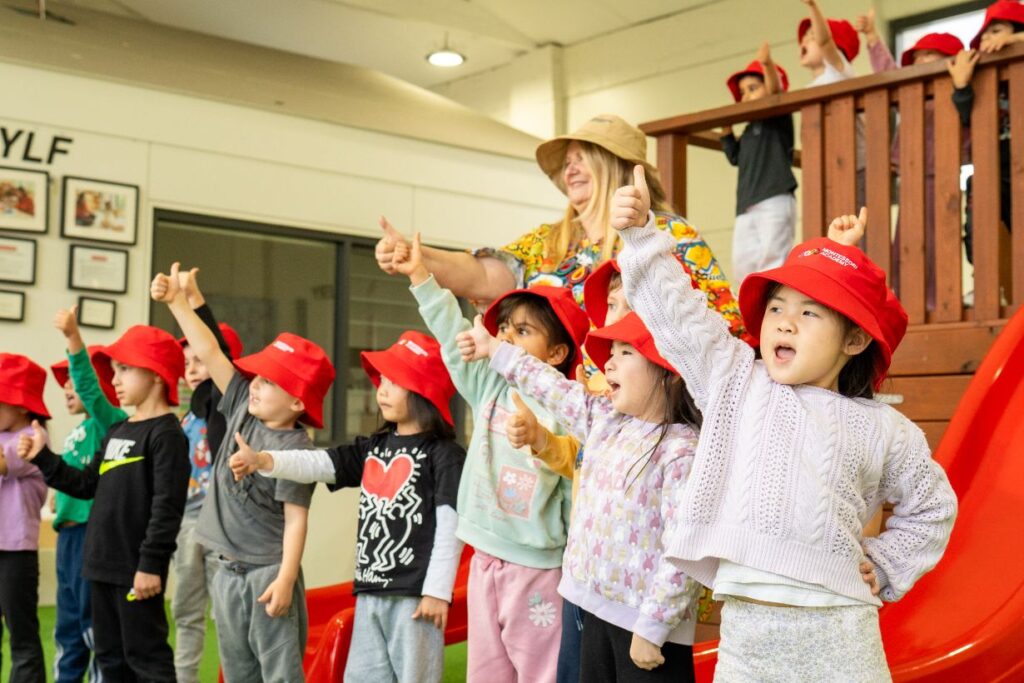
Montessori Academy has partnered with Holly-ann Martin OAM, Founder and Managing Director of Safe4Kids, and a leading protective education expert with more than 30 years’ experience, to deliver the Safe4Kids Protective Education Program across our services.
The partnership strengthens Pillar Six of our Seven Pillars of Child Safety: Empowering Children’s Voices, creating a consistent, shared language around feelings, body safety, personal boundaries, trusted adults and seeking help.
Protecting children is the responsibility of the adults, organisations and communities around them. Through weekly lessons covering 10 key safety concepts, children build age-appropriate knowledge about their rights, how to recognise when something does not feel right, and how to speak up and seek help. Most importantly, they learn that their voice matters and when they speak, adults will listen, respond and act.
The program supports more than 7,000 children and their families, while equipping educators across our network with the knowledge, confidence and practical tools to reinforce these concepts every day.
By creating a shared language between children, educators and families, Safe4Kids helps build a community where children feel confident to speak up and the adults around them are better prepared to listen, respond and take appropriate action.
“Protective education is not about placing responsibility on children. It helps them understand their rights, recognise trusted adults and know they will be heard and supported when they speak up. Age-appropriate body safety education gives children practical skills and confidence they can carry through life.”
— Holly-ann Martin, OAM, Director and Founder of Safe4Kids Tweet
From industry-leading technology and governance to advanced training and quality systems, our safeguards go beyond regulatory requirements because child safety always comes first. Every decision. Every action. Every day.From industry-leading technology and governance to advanced training and quality systems, our safeguards go beyond regulatory requirements because child safety always comes first. Every decision. Every action. Every day.
A low Quality and Safety Manager-to-centre ratio ensures close, proactive compliance oversight across every centre, complemented by dedicated senior compliance specialists who support consistent safety culture organisation-wide.
The only long day childcare provider in Australia certified to ISO 9001 (Quality), ISO 14001 (Environmental), and ISO 45001 (Health & Safety) — adding independent international auditing.
Industry-first digital system continuously monitoring WWCC status, staff qualifications, and compliance records in real time. Instant alerts if any educator’s clearance status changes.
Child safety is a standing agenda item in all team and leadership meetings. A zero-tolerance policy for any breach is embedded organisation-wide, not as a compliance obligation, but as a cultural expectation.
A dedicated Child Safety Officer at every single service ensuring daily accountability, proactive safety culture, and immediate response to any concern.
Every educator holds current First Aid, CPR, and Child Protection qualifications — fully funded and maintained by Montessori Academy to remove barriers and ensure consistency.
Adults must defend children. We adults must see the real humanity in children, the humanity which will take our place one day, if we are to have social progress.
— Doctor Maria Montessori
Child Safeguarding at Montessori Academy
At Montessori Academy, we protect, nurture, and empower every child, building the foundations for an extraordinary future through excellence, safety, and care in everything we do. See below to learn more about our approach to safeguarding children.
At Montessori Academy, we are fully committed to providing a safe, inclusive, and nurturing environment where all children and young people feel valued, respected, and protected. We acknowledge our responsibility to uphold the National Child Safe Principles and implement the Child Safe Standards to strengthen our ability to prevent, identify, and respond to any risks or incidents of child abuse.
Child protection is our highest priority. We ensure all staff members undergo comprehensive screening prior to employment, including Working with Children Checks, detailed inductions on child safety policies and procedures, and ongoing training in child protection, appropriate interactions, and mandatory reporting obligations. These measures ensure that every employee is equipped with the knowledge and skills necessary to maintain a safe and supportive environment for children and young people.
Our service maintains clear guidelines on acceptable and unacceptable behaviour between adults and children, ensuring professional boundaries are upheld at all times. These expectations extend to all staff, volunteers, contractors, and the wider community, reinforcing our zero-tolerance approach to any form of abuse or harm.
We have a Child Safe Environment Policy that aligns with the Child Safe Standards, reinforcing our strong commitment to safeguarding children and ensuring their well-being. Additionally, our Child Protection Policy outlines our legal and ethical responsibilities regarding mandatory reporting, ensuring that any concerns related to physical, sexual, emotional, or psychological abuse or neglect are reported and addressed promptly, appropriately, and lawfully.
In accordance with the United Nations Convention on the Rights of the Child, we actively promote children’s right to safety, protection, and self-expression. We empower children to speak up if they feel unsafe and encourage their participation in decisions that affect them. Their voices are heard, respected, and valued within our service.
As part of our ongoing commitment to child safety, we welcome feedback from children, families, and carers, taking all concerns seriously and addressing them with transparency and urgency. Our policies and procedures are regularly reviewed and updated to reflect best practices, legislative changes, and the evolving needs of our community, ensuring continuous improvement in our child protection measures.
At Montessori Academy, we stand united in our commitment to fostering a culture of safety, trust, and respect for every child in our care.
At Montessori Academy, child safety begins before employment and continues throughout every stage of the employee lifecycle. Our child safe recruitment practices are designed to attract, select and retain educators who demonstrate the highest standards of professional conduct and a genuine commitment to safeguarding children. Through rigorous screening, comprehensive background checks, qualification verification, child-safe interviewing, mandatory training, ongoing compliance monitoring and a culture of accountability, we ensure every person working within our services understands their responsibility to protect children and uphold the highest standards of safety, wellbeing and professional practice. Our child safe recruitment practices include:
Recruitment and Position Design
- Child safety responsibilities are embedded into relevant job descriptions.
- Position descriptions outline expectations relating to child protection, child safety legislation, organisational policies and the Child Safe Code of Conduct.
- All external job advertisements state that Montessori Academy is a child safe organisation.
- Recruitment agencies must follow Montessori Academy’s child safe screening requirements when sourcing candidates.
Child Safe Candidate Screening
- Candidates are screened by Human Resources before progressing to interview.
- Screening questions assess the applicant’s understanding of child safety, professional boundaries and suitability to work in a child-related environment.
- Interviews include specific questions or scenarios relating to child protection legislation, safe conduct with children and professional boundaries.
- Leadership candidates may be assessed further through a second-round interview with a member of the senior executive team.
Employment and Conduct History
- Candidates must provide a Declaration of Employment History.
- Candidates must provide a Declaration of Disciplinary and Investigative History.
- Employment history is reviewed for gaps or concerns relevant to the candidate’s suitability to work with children.
- Any information raising concerns about past conduct, professional boundaries or child safety is considered before employment progresses.
Child Safety-Focused Reference Checks
- A minimum of two documented reference checks are completed before an offer of employment is made.
- Reference checks include questions about the applicant’s past conduct, professional boundaries and attitudes towards child protection.
- Referees are asked to confirm the applicant’s suitability to work with children and disclose any known history of misconduct or concerns.
- Human Resources seeks further clarification where reference feedback is unclear.
Working With Children Check Verification
- Candidates must hold a current paid Working With Children Check.
- The Working With Children Check is verified as part of the recruitment and onboarding process.
- Candidates completing a classroom trial must provide a valid Working With Children Check before entering the learning environment.
- Working With Children Check status is monitored alongside qualifications and compliance records through Montessori Academy’s compliance systems.
Prohibited Persons Checks
- All preferred candidates undergo a Prohibited Persons Check before their employment is confirmed.
- Candidates must not commence employment until the check has been completed and cleared.
- Where a candidate is identified as a prohibited person, the recruitment process ceases immediately.
- Outcomes are securely recorded in Montessori Academy’s compliance records.
National Police Checks for Permanent Staff
- All permanent employees undergo a National Police Check as an additional internal child safety safeguard.
- Montessori Academy initiates and fully funds the Police Check.
- The Police Check must be returned with a satisfactory result within 14 days of commencement.
- This requirement operates in addition to Working With Children Checks and Prohibited Persons Checks.
Identity, Qualification and Certification Verification
Before commencing employment, candidates must provide and have relevant documentation verified, including:
- Photo identification
- ACECQA-recognised qualifications
- Academic transcripts or confirmation of current study
- A current paid Working With Children Check
- A current Child Protection certificate
- Current First Aid and CPR qualifications
- Current Asthma and Anaphylaxis qualifications
- National Police Check documentation for permanent employees
Supervised Classroom Observation
- Candidates complete a 30-minute classroom trial to assess their practical suitability, conduct and alignment with Montessori Academy’s culture.
- Candidates are continuously supervised throughout the observation.
- Candidates must never be left alone with children.
- Candidates are required to sign in and out of both the service and the classroom.
- Candidates are not permitted to use Montessori Academy devices during the observation.
Mandatory Documentation and Policy Acknowledgement
Before commencement, successful candidates must complete, acknowledge and sign key employment and child safety documents, including:
- Child Protection Policy
- Child Safe Code of Conduct
- Prohibited Employment Declaration
- Dealing with Medical Conditions Policy
- Relevant employment policies
- Montessori Academy’s Integrated Management System Policy
Missing documentation may delay onboarding or prevent the employee from commencing.
Child Safety Induction
All new employees complete a structured induction program that includes:
- Mandatory Policies and Procedures Training
- Child Protection Induction Training
- Child Safe Code of Conduct responsibilities
- Montessori Academy’s zero-tolerance approach to harm
- Incident reporting procedures
- Emergency procedures
- Supervision requirements
- Staff-to-child ratios
- Headcount procedures
- Outdoor supervision protocols
- Child protection drills
- Medical conditions and behaviour guidance policies
Mandatory Qualifications and Training
- Every educator holds current First Aid, CPR and Child Protection qualifications.
- Montessori Academy fully funds and maintains these qualifications to remove barriers and promote consistency across the network.
- Educators are trained as Mandatory Reporters and are legally required to report concerns about a child’s safety or wellbeing.
- Induction is supported by annual training requirements, face-to-face learning, online webinars and ongoing refresher training.
- Montessori Academy’s broader training framework includes child safety, behavioural practices, regulatory compliance, leadership and Montessori pedagogy.
- Regular medical emergency response and child protection drills reinforce staff capability in practice.
Ongoing Monitoring and Support
- New employees complete onboarding surveys at two weeks, one month and 90 days.
- The 90-day survey assesses their understanding of child safe obligations.
- Human Resources and the employee’s Nominated Supervisor continue regular check-ins during the first six months.
- Ongoing professional development, performance reviews and policy training reinforce child safety expectations throughout employment.
Our Difference
Montessori Academy’s child safe recruitment framework goes beyond a single clearance or background check. It combines child safety-focused advertising, structured screening, scenario-based interviews, declarations of employment and disciplinary history, multiple reference checks, Working With Children Check verification, Prohibited Persons Checks, National Police Checks for permanent employees, supervised classroom observations, qualification verification, mandatory induction and ongoing training.
Together, these safeguards help ensure that every person joining Montessori Academy understands their professional responsibilities, is appropriately screened and qualified, and is prepared to uphold our commitment:
Child Safety Always Comes First. Every decision. Every action. Every day.
At Montessori Academy, child safety and wellbeing are our highest priorities and a shared responsibility across every level of our organisation.
We build a strong culture of safety through clear leadership, rigorous systems and consistent everyday practice. Daily compliance checks, regular safety reviews, monthly audits and ongoing oversight by our Senior Compliance Team help ensure risks are identified early and addressed promptly. Our Quality and Safety Managers also conduct regular reviews using our internal Quality Assurance Framework to monitor performance and support alignment with the National Quality Standard.
Importantly, child safety is not treated as a once-a-year training requirement or a matter of compliance alone. It is reinforced through ongoing professional development, mandatory annual child protection training, regular team meetings, clear reporting and escalation pathways, and consistent communication from leaders.
Every team member is expected to remain vigilant, speak up, challenge unsafe practice and act immediately when something does not feel right. By keeping child safety visible in daily decisions, team conversations and leadership accountability, we create an environment where children feel safe, respected, supported and heard.
All Montessori Academy educators and relevant staff are Mandatory Reporters and are legally required to report any concerns relating to the safety, welfare or wellbeing of a child. These responsibilities are embedded throughout our Child Safe Framework and reinforced through comprehensive induction, mandatory annual child protection training, ongoing professional development and regular policy reviews.
We maintain a strong culture of vigilance, accountability and shared responsibility, where safeguarding children is recognised as the responsibility of every employee, every day. Team members are supported by clear reporting pathways, experienced leaders and our dedicated Compliance Team to ensure concerns are identified, escalated and responded to appropriately.
Every allegation, concern or incident is taken seriously. Reports are assessed and investigated promptly, with immediate action taken where required to protect children. Montessori Academy works closely with relevant authorities and regulatory agencies, ensuring all legislative and mandatory reporting obligations are met while maintaining a child-centred, transparent and responsive approach.
At Montessori Academy, comprehensive health, safety and child protection policies provide the foundation for protecting the wellbeing of every child. Our policies align with the National Law, National Regulations, National Quality Standard and Child Safe Standards, and are regularly reviewed to reflect legislative changes, emerging best practice and continuous improvement. They provide clear guidance across all aspects of service delivery, including child protection and mandatory reporting, supervision, safe sleep and rest, medical conditions, medication administration, personal care, incident and emergency management, infectious diseases, food safety, excursions and risk management.
Every team member receives training on these policies during induction and completes mandatory annual child safety and child protection training, supported by ongoing professional development and regular policy updates throughout the year. This ensures educators remain informed of legislative requirements, understand their responsibilities as Mandatory Reporters and consistently apply safe practices that place the best interests of every child at the centre of every decision.
We are also committed to transparency and strong partnerships with families. All policies required under Regulation 168 are accessible through our family communication app, with a complete physical copy available at the reception of every Montessori Academy service. Families also receive an overview of key policies through the Family Handbook and Orientation Pack, helping them understand the safeguards, procedures and expectations that support their child’s health, safety and wellbeing from the beginning of their enrolment.
Montessori Academy has a dedicated Quality, Safety and Compliance function responsible for leading our organisation-wide approach to child safety, safeguarding, regulatory compliance and continuous improvement.
Our Head of Quality and Safety, Head of Governance, and Quality and Safety Managers work closely with Centre Managers and Child Safety Officers to oversee the consistent implementation of child-safe policies, practices and reporting requirements across every service. This includes monitoring daily compliance activities, reviewing audit outcomes, analysing incidents and emerging risks, tracking corrective actions and providing targeted support where improvement is required.
Child safety performance is escalated daily through senior leadership and governance channels to ensure clear accountability, timely decision-making and organisation-wide oversight. These reviews help confirm that safeguarding priorities remain on track, identified risks are addressed promptly and lessons from incidents or audits are translated into stronger practices across the network.
Our governance approach is supported by our internal Quality Assurance Framework and real-time compliance systems, which provide visibility across areas such as supervision, safe sleep, staff qualifications, Working With Children Checks, training completion, environmental safety checks and regulatory obligations.
Importantly, our compliance team does more than monitor whether requirements have been completed. They work alongside centre leaders to strengthen capability, reinforce expectations and embed a culture where child safety is actively discussed, continuously reviewed and treated as everyone’s responsibility.
Transparency, accountability and timely action are fundamental to Montessori Academy’s approach to incident management and child safety. Every incident involving injury, trauma, illness, a safeguarding concern or a breach of expected practice is treated seriously and managed in accordance with our policies, regulatory obligations and the best interests of the child.
Incidents are documented promptly and comprehensively, with families informed as soon as practicable and within required timeframes. Where an incident meets the relevant notification threshold, the Regulatory Authority and other appropriate agencies are notified without delay. Clear escalation pathways ensure Centre Managers, Quality and Safety Managers and our Senior Compliance Team are informed and involved according to the nature and seriousness of the matter.
Significant incidents undergo a structured internal review to establish what occurred, identify contributing factors and determine the corrective action required. Depending on the circumstances, this may include reviewing CCTV footage, witness statements, supervision records, staffing arrangements, room layouts, risk assessments and relevant policies and procedures.
Immediate action is taken wherever necessary to protect children and reduce further risk. This may include strengthening supervision, adjusting staffing or room arrangements, removing hazards, providing additional leadership oversight, retraining team members or implementing further control measures while a review is underway.
Findings are used to strengthen practice and prevent recurrence across the service and, where relevant, the wider organisation. Actions may include updating supervision plans and risk assessments, conducting targeted safety audits, refining policies and procedures, providing additional training and monitoring the effectiveness of improvements over time.
This approach is reinforced through daily compliance check-ins, weekly compliance meetings, regular policy reviews, continuous staff training and ongoing safety audits. Centre Managers, Quality and Safety Managers and senior leaders review incidents, emerging risks and recurring themes to ensure lessons are identified, shared and acted upon.
Together, these systems support compliance with child protection responsibilities, mandatory reporting obligations, notification requirements and organisational policies. More importantly, they ensure concerns are not simply recorded, but thoroughly reviewed and used to strengthen the safety, quality and accountability of the education and care we provide.
Extraordinary futures begin with highly skilled, supported and dedicated educators.
At Montessori Academy, we believe the quality of our workforce directly influences the safety, consistency and educational experience of every child. We invest significantly in attracting, developing and retaining outstanding educators through sponsored qualifications, structured professional development, leadership pathways and a strong culture of continuous improvement.
The majority of our permanent educators hold a Diploma or Bachelor qualification, with more than 100 team members currently advancing their qualifications through Montessori Academy’s sponsored study program. Every educator also holds current First Aid, CPR and Child Protection qualifications, which are fully funded and maintained by Montessori Academy to support consistent standards across our network.
Our comprehensive training framework supports educators from induction through to ongoing professional development. Delivered through internally developed programs, specialist trainers and experienced leaders, it includes Montessori pedagogy, child safety, behavioural practice, regulatory compliance and leadership development. This ensures educators are equipped with the knowledge, confidence and practical skills required to deliver safe, high-quality and consistent education and care.
As a Great Place to Work Certified™ organisation, we foster a culture where educators feel valued, recognised and supported to grow. Through ongoing coaching, professional development, wellbeing initiatives and meaningful career pathways, we strengthen team capability, improve workforce continuity and create the stable, trusted relationships children need to feel secure and thrive.
Our people are one of our strongest safeguards. By investing in their qualifications, capability and wellbeing, we support safer environments, stronger educational outcomes and an exceptional Montessori experience for every child.
The National Principles for Child Safe Organisations are informed by the ten Child Safe Standards recommended by the Royal Commission into Institutional Responses to Child Sexual Abuse. Their scope extends beyond sexual abuse to address all forms of child abuse, neglect, exploitation and harm.
At Montessori Academy, we believe being a child safe organisation means going beyond minimum regulatory requirements. We are committed to embedding the National Principles across every service and every level of our organisation, creating environments where children’s rights, safety, wellbeing and best interests are upheld in every decision, every action, every day.
Guided by our “See Something, Say Something” culture, we empower every team member to remain vigilant, speak up and act immediately when something does not feel right. We also work in partnership with families and communities to promote cultural safety, strengthen protective practices and ensure children feel heard, respected and supported.
Through ongoing educator training, strong governance, clear reporting pathways and continuous review, we strive to build a culture where child safety is understood as everyone’s responsibility and where children can learn, grow and thrive with confidence.
Annual Child Safety Conference
In 2026, Montessori Academy brought our leadership team together at NSW Parliament House for our Leadership and Safety Conference, reinforcing our commitment to placing the best interests of every child at the centre of every decision.
The forum strengthened leadership capability, safeguarding processes and accountability at every level, challenging leaders to consider not just the systems that protect children, but how those systems translate into daily practice.
The message was clear: leadership and safety are not separate responsibilities. They are the same job, always in service of the best interests of every child.
Protecting children requires strong leadership, robust governance and a culture where safety is embedded in every decision. We remain committed to strengthening our practices and delivering the highest standards of education and care.
Children are human beings to whom respect is due, superior to us by reason of their innocence and of the greater possibilities of their future.
— Doctor Maria Montessori
Learn more about how each of our seven pillars helps to keep children safe.
Prevention through Rigorous Recruitment & Screening Preventing harm before it reaches a child
Capability through Training Equipping every educator with the knowledge to act
Layered Protection Through Integrated Safety Systems Strong systems support safe pe
Active Supervision as the Most Important Practice Safety is actively monitored, never assumed
A Culture of Speaking-up & Transparency Protecting children is everyone’s responsibility
Empowering Children’s Voices Protective behaviours, inclusion and family partnerships
Strong Governance and Accountability Acting immediately, transparently, decisively
Enquire About Enrolling
New Childcare & Tour Enquiry
We'd love to find the perfect place for your child. This takes about 2 minutes.
Second Child
Thank you for your enquiry!
We've received your details and a member of our team will be in touch within one business day to discuss the next steps for your family.
See Something. Stop It. Say Something.
Every concern matters. If you have a child safety concern, whether you are a parent, family member, staff member, or community member, please speak up. Your voice protects children.
Join a thriving community of families who trust Montessori Academy as their early education partner, backed by more than 25 years of experience, over 100 years of proven Montessori education, and the trust of more than 100,000 Australian families.