Safe4kids child protection education
Safe4Kids Protective Education
Montessori Academy partners with Safe4Kids to strengthen protective education for children, educators and families across our early learning services.
Empowering children to speak up, stay safe and be heard with Safe4Kids
Montessori Academy has partnered with Holly-ann Martin OAM, Founder and Managing Director of Safe4Kids and a leading expert in protective education with more than 30 years of experience, to deliver the Safe4Kids Protective Education Program to our children, educators, and families.
The partnership strengthens Pillar Six of our Seven Pillars of Child Safety: Empowering Children’s Voices, creating a shared language around feelings, body safety, personal boundaries, trusted adults and seeking help.
Protecting children is the responsibility of the adults, organisations and communities around them. Through weekly lessons exploring 10 key safety concepts, children are supported to understand that their voice matters and that when they speak up, they will be listened to and supported.
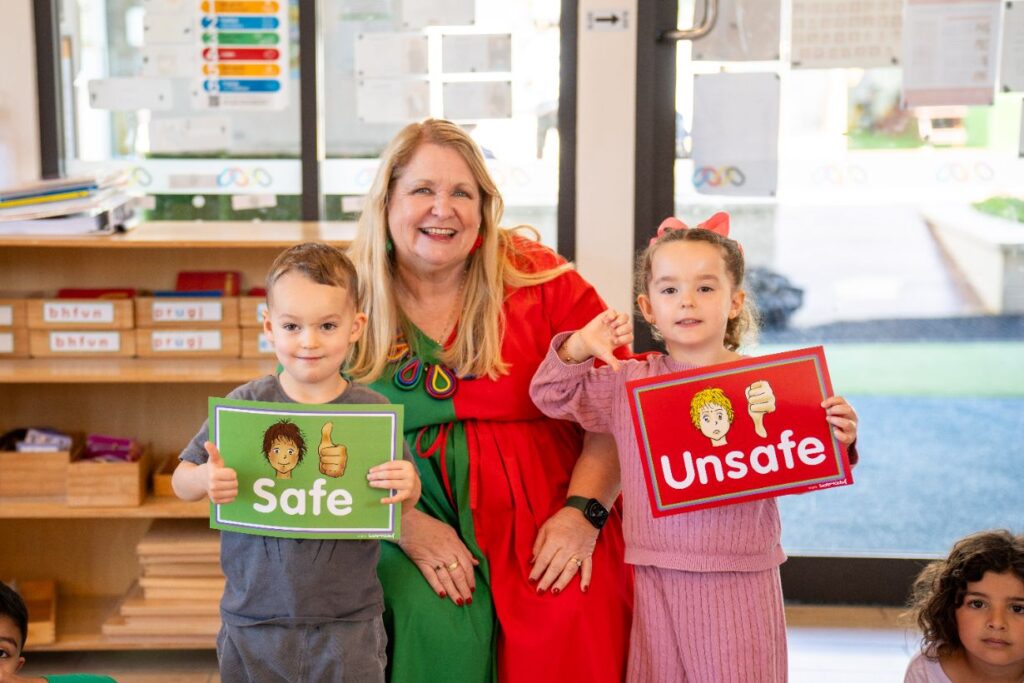
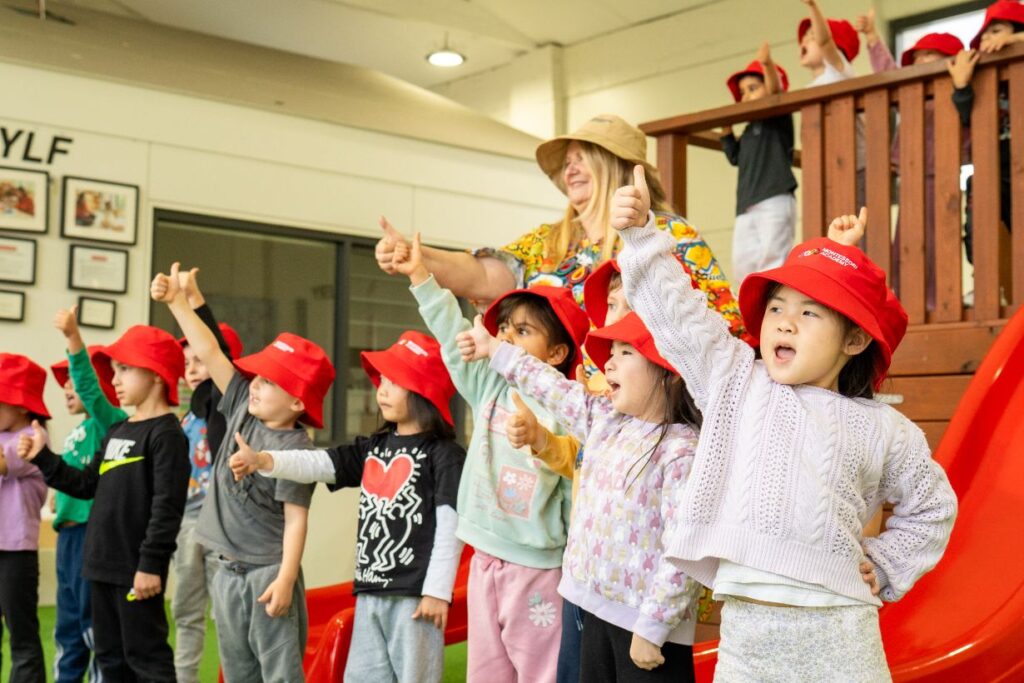
What is Protective Education?
Protective education is age-appropriate learning that helps children understand their rights, recognise when something feels unsafe, understand personal boundaries and body safety, and know how to speak up and seek help from trusted adults.
Through our partnership with Safe4Kids, children develop these skills through engaging learning experiences including games, activities and music. They explore feelings, personal space, Early Warning Signs, trusted adults and the importance of continuing to tell until someone listens, while developing confidence, assertiveness, persistence and resilience.
Through our Safe4Kids Protective Education Program, children explore 10 key concepts that build the language, confidence and practical skills to understand their rights, recognise when something feels unsafe and seek help from trusted adults.
Safe & Unsafe
Recognising situations and communicating how they feel.
Safe Touches & Unsafe Touches
Building bodily autonomy, consent and personal boundaries.
Feelings
Naming, expressing and understanding emotions.
Early Warning Signs & Telling
Listen to body clues and knowing when to tell.
Risking on Purpose
Making confident, thoughtful choices.
Safety Team
Identifying trusted adults and asking for help.
Persistence In Telling
Keep telling until someone helps.
Public & Private
Understanding privacy and respectful boundaries.
Saying ‘No’, Personal Space & Relationships
Building assertiveness and safe responses.
Secrets
Knowing safe and unsafe secrets, and seeking support.
Educating Children, Educators and Families
The Safe4Kids Protective Education Program supports more than 7,000 children and their families, while equipping educators across our network with the knowledge, confidence and practical tools to strengthen child safety every day.
By creating a consistent, shared language around child safety, the program helps children understand their rights, recognise when something does not feel right, and know how to speak up and seek help. At the same time, families and educators are better equipped to reinforce these messages, listen, respond and take appropriate action.
- Children: Building age-appropriate knowledge, language and confidence around body safety, personal boundaries, their rights, trusted adults and how to seek help.
- Families: Providing practical tools and a shared language to continue important child safety conversations at home and reinforce key protective behaviours.
- Educators: Strengthening the knowledge, confidence and skills to teach protective behaviours, recognise concerns, respond appropriately and support children to feel safe, heard and empowered.
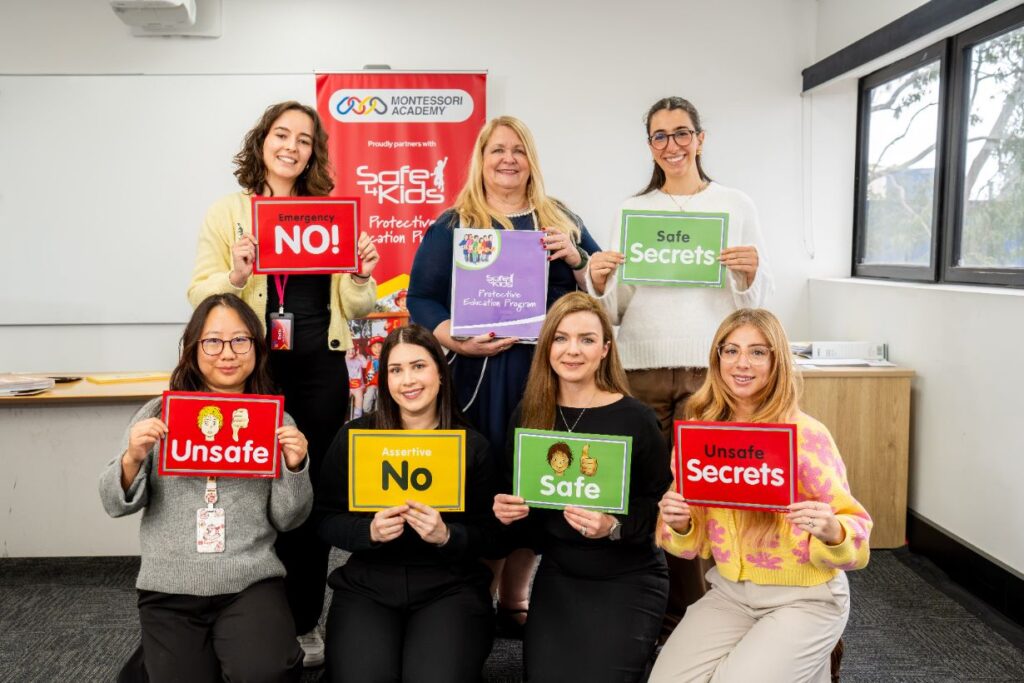
Safe4Kids Strengthens Pillar 6: Empowering Children's Voices
At Montessori Academy, child safety is our highest priority, embedded in every policy, practice and safeguard across our services. Our Seven Pillars of Child Safety bring together the people, systems and protections that surround every child, every day. Through Pillar Six, Safe4Kids helps children understand that their feelings matter and gives them age-appropriate language, confidence, boundary awareness and help-seeking skills to speak up when something feels worrying, unsafe or uncomfortable. When families and educators use the same language, children have a stronger circle of safety.
Preventing harm before it reaches a child
Preventing harm before it reaches a child
Robust recruitment and vetting processes ensure all staff are suitable to work with children. From WWCC verification to psychometric testing for leaders, we leave nothing to chance.
🆚 National Regulations vs Our Difference
| National Regulation | Montessori Academy Goes Further |
|---|---|
| WWCC required before commencing work with children | Compliance Passport monitors WWCC status in real-time, 24/7 — instant alert if any clearance lapses or changes ★ Industry First |
| National police check required for approved providers | National police checks for all new permanent staff, plus psychometric testing for all leadership roles ↑ Exceeds |
| Reference checks as part of fit and proper person assessment | Fraud-detection platform verifies all references for authenticity — detecting fraudulent references before appointment ↑ Exceeds |
| Agency and casual staff permitted without additional vetting requirements | Minimised agency reliance — strong internal casual pool, all verified via Compliance Passport and performance-rated ↑ Exceeds |
| Contractor access not specifically mandated beyond general supervision | Contractor screening protocols and supervised escorted access at all centres at all times ↑ Exceeds |
Capability Through Training
Equipping every educator with the knowledge to act
All educators complete Mandatory Child Protection Training and are trained as Mandatory Reporters. Our comprehensive training framework goes far beyond the minimum requirements.
🆚 National Regulations vs Our Difference
| National Regulation | Montessori Academy Goes Further |
|---|---|
| Mandatory child protection training required for all nominated supervisors, staff and volunteers | 100% of staff hold current First Aid, CPR & Child Protection qualifications — fully funded by MA ↑ Exceeds |
| National child safety training modules required; refresher every 2 years | Structured end-to-end training framework from induction through to ongoing professional development ↑ Exceeds |
| Staff must be advised of child protection laws and their obligations | Dedicated team of Montessori Trainers and Quality and Safety Managers delivering regular face-to-face coaching, mentoring and professional development across our centres ★ Industry First |
| Mandatory reporting obligation under state child protection legislation | Mandatory reporting responsibilities are regularly reinforced through ongoing training, policy updates and leadership communication, guided by our See Something, Stop It, Say Something approach. ↑ Exceeds |
Layered Protection Through Integrated Safety Systems
Strong systems support safe people
24/7 CCTV with AI-powered Intelligent Safety Alerts at select locations, secure entry systems, and LifeVac choking response devices create multiple layers of physical protection at every centre.
🆚 National Regulations vs Our Difference
| National Regulation | Montessori Academy Goes Further |
|---|---|
| CCTV not mandated | 20 years of CCTV coverage at all centres with AI-powered Intelligent Safety Alerts at select locations ★ Industry First |
| Basic access control | Secure entry systems with approved access cards for all staff and families ↑ Exceeds |
| Visitor sign-in required | Mandatory sign-in, ID verification, and escorted access at all times ↑ Exceeds |
| First aid equipment required | First Aid equipment as well as LifeVac choking response devices onsite at every centre ↑ Exceeds |
| Digital technology policy required including rules on device use by staff and children | Strict technology policy: personal devices prohibited while working with children — enforced across all centres ↑ Exceeds |
Active Supervision as the Most Important Practice
Safety is actively monitored, never assumed
Our no-unsupervised-contact policy ensures no child is ever alone with one adult out of sight of others. Audited supervision plans are enforced across every centre.
🆚 National Regulations vs Our Difference
| National Regulation | Montessori Academy Goes Further |
|---|---|
| Active supervision required | Detailed, audited supervision plans — children always within sight and hearing of multiple educators ↑ Exceeds |
| Educator-to-child ratios mandated (e.g. 1:4 under 2s; 1:5 for 2–3 year olds; 1:10 for 3–5 year olds) | Educator-to-child ratios are carefully monitored throughout the day to ensure they meet or exceed regulatory requirements at all times, supporting active supervision, responsive care and safer learning environments. |
| Safe sleep policies and procedures required; physical sleep checks mandated | Staff physically check on sleeping children every 10 minutes PLUS Cot Room Monitors providing continuous visual oversight ↑ Exceeds |
| No specific policy on adult-child contact | Strict no-unsupervised-contact policy — no child ever alone with one adult out of sight ★ Industry First |
| Premises must be designed to facilitate supervision of children | Purpose-built and purposefully prepared Montessori environments are designed to support clear lines of sight, effective supervision and safe movement throughout the day, with comprehensive safety checks completed before children arrive each morning. ↑ Exceeds |
A Culture of Speaking-up & Transparency
Protecting children is everyone’s responsibility
An open reporting culture for staff and families, with clear escalation pathways and immediate investigation procedures. See Something, Stop It, Say Something.
🆚 National Regulations vs Our Difference
| National Regulation | Montessori Academy Goes Further |
|---|---|
| Mandatory reporting obligations — all educators legally required to report suspected abuse or neglect | Open reporting culture actively promoted at all levels — a cultural expectation embedded in induction, not just a legal obligation. See Something, Stop It, Say Something. ↑ Exceeds |
| Regulatory authority must be notified within 24 hours of any physical or sexual abuse allegation | All serious incidents reported within 24 hours plus clear escalation pathways with immediate investigation, regulatory notification, and family communication — no delays ↑ Exceeds |
| Families must be notified of incidents, injury, trauma or illness involving their child | Active family engagement with policies and safety practices — families are partners in child safety, not passive recipients ↑ Exceeds |
| No specific regulatory requirement for a speak-up or safety culture beyond compliance obligations | Great Place to Work™ Certified — an independently verified culture of safety and trust embedded organisation-wide ★ Industry First |
| Child safety explicitly named in NQS Quality Area 2 — staff must identify and respond to children at risk | Child safety is a standing agenda item in all team and leadership meetings — driving continuous improvement, not just compliance ★ Industry First |
Empowering Children’s Voices
Protective behaviours, inclusion and family partnerships
Children are empowered to speak up, understand their rights, and participate in their own safety. Parent sessions, community engagement, and the Montessori approach to child voice.
🆚 National Regulations vs Our Difference
| National Regulation | Montessori Academy Goes Further |
|---|---|
| Children's rights acknowledged under the UNCRC | Dedicated 'Empowering Children's Voices' curriculum integrated into Montessori pedagogy — children's rights taught daily ↑ Exceeds |
| Family communication required for significant incidents and general service information | Daily family communication and regular child safety and protective behaviours resources help keep families informed, connected and empowered. ↑ Exceeds |
| No specific regulatory requirement for child voice or participation in safety decisions | Children actively participate in decisions that affect them — voices heard, respected, and valued as part of daily practice ↑ Exceeds |
| Community engagement encouraged under NQS but not mandated under National Regulations | Partnership with national and local community organisations for holistic, evidence-based child protection ↑ Exceeds |
| No specific requirement for a protective behaviours curriculum under National Regulations | Protective behaviours, body autonomy and age-appropriate consent education are embedded into our program from the earliest years, helping children understand their rights, recognise unsafe situations and feel confident using their voice ↑ Exceeds |
Strong Governance and Accountability
Acting immediately, transparently, decisively
Aligned with National Principles for Child Safe Organisations and all regulations. Triple ISO Certification adds a layer of independent international auditing unique to Montessori Academy.
🆚 National Regulations vs Our Difference
| National Regulation | Montessori Academy Goes Further |
|---|---|
| NQS compliance required with quality assessment and rating against 7 quality areas | NQS compliant plus triple ISO Certification (9001, 14001, 45001) — the only childcare provider in Australia to achieve all three simultaneously ★ Industry First |
| Annual quality improvement plan review required | Daily and weekly compliance checks, monthly audits and risk assessments at every centre — far exceeding annual requirements ↑ Exceeds |
| No specific requirement for a dedicated child safety officer at centre level | Child Safety Officer in every single centre — dedicated daily accountability and proactive safety culture at the frontline ↑ Exceeds |
| Governance must support a quality, child safe service | Low Quality & Safety Manager-to-centre ratio with proactive compliance oversight and an industry-leading governance structure ↑ Exceeds |
| Alignment with National Principles for Child Safe Organisations required | Alignment with National Principles AND NSW Child Safe Standards — exceeding NQS governance requirements ↑ Exceeds |
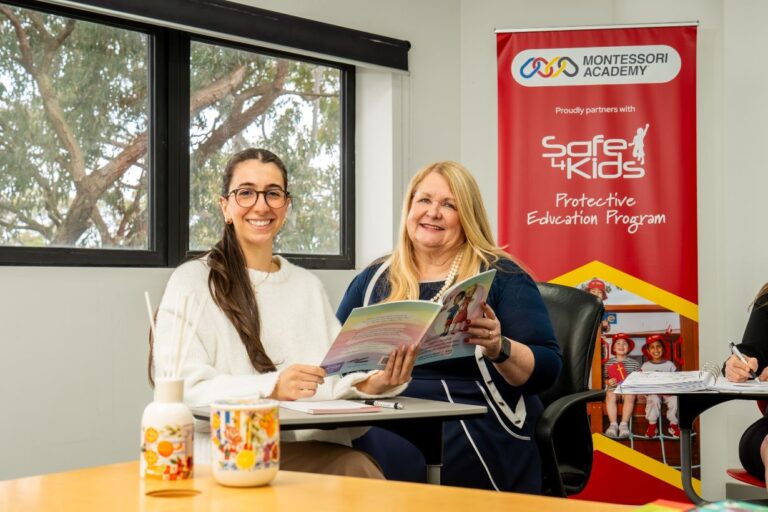
Holly-ann Martin, OAM, Director and Founder of Safe4Kids
“Protective education is not about placing responsibility on children. It helps them understand their rights, recognise trusted adults and know they will be heard and supported when they speak up. Age-appropriate body safety education gives children practical skills and confidence they can carry through life.”
Holly-ann Martin OAM is a nationally recognised child safety educator with more than 30 years’ experience in child protection and protective education.
Her work began in the 1980s, teaching children age-appropriate concepts around body safety, boundaries and safe and unsafe touch. Seeing the need for stronger resources and education for children, families and educators, she founded Safe4Kids in 2011.
Today, Safe4Kids delivers protective education programs, training and resources across Australia. Holly-ann was awarded the Medal of the Order of Australia in 2022 for her service to child safety education.
- 30+ years in child safety education
- Founder and Director of Safe4Kids
- Protective education specialist
- Medal of the Order of Australia (OAM), 2022
Please encourage your child to talk with you about what they have learnt through the Safe4Kids Protective Education Program. We encourage you to reinforce key concepts by:
Reinforce Safe4Kids terms at home so children hear clear, consistent messages from the adults around them.
Help your child name safe, unsafe and confused feelings, and encourage them to talk about how situations make them feel.
Model consent by respecting “No” and “Stop”, asking before physical affection and reinforcing personal space.
Regularly talk about the trusted adults your child can turn to if they feel worried, uncomfortable or unsafe.
Reassure your child that they can tell you anything and will be listened to, supported and not blamed.
Encourage your child to use a clear, confident voice when saying “No”, “Stop” or asking an adult for help.
Use anatomically correct names for body parts and reinforce simple concepts around public, private and appropriate boundaries.
Turn daily experiences into opportunities to talk about safety, choices, trusted adults, resilience and seeking help when needed.
About the Safe4Kids Program
At Montessori Academy, we protect, nurture, and empower every child, building the foundations for an extraordinary future through excellence, safety, and care in everything we do. See below to learn more about our approach to safeguarding children.
Protective Education is age-appropriate learning that helps children understand their rights, recognise when something feels unsafe, understand personal boundaries and body safety, and know how to speak up and seek help from trusted adults.
Through our partnership with Safe4Kids, children explore these concepts through engaging learning experiences including games, activities, music and discussion.
No. Keeping children safe is always the responsibility of adults, educators, organisations and the broader community.
Protective Education adds another layer of protection by giving children age-appropriate language and confidence to communicate how they feel, understand their rights and seek help. Montessori Academy’s broader Seven Pillars of Child Safety bring together the people, systems, supervision, safeguards and governance that surround every child.
Children explore 10 key concepts covering Safe and Unsafe, Safe and Unsafe Touches, Feelings, Early Warning Signs and Telling, Risking on Purpose, Safety Teams, Persistence, Public and Private, Saying “No”, Personal Space and Relationships, and Secrets.
Together, these concepts help children build language, confidence, boundary awareness, assertiveness, resilience and help-seeking skills.
Yes. As part of the Public and Private concept, children are introduced to correct anatomical names for private body parts in a simple, factual and age-appropriate way.
Using correct terminology helps children understand their bodies, supports respectful conversations about body safety and gives them clear language to communicate if something makes them feel uncomfortable or unsafe. Families are encouraged to reinforce the same terminology at home and avoid describing private body parts as rude, dirty or shameful.
No. The program is focused on protective education and body safety, not sex education.
Children learn age-appropriate concepts including public and private, personal boundaries, consent, trusted adults, Early Warning Signs and how to speak up if something feels uncomfortable or unsafe.
Sensitive topics are introduced using language appropriate for young children. For example, Safe4Kids uses the terms “private pictures” and “private movies” when discussing inappropriate content children may accidentally encounter.
Children are taught that if they see something inappropriate or confusing, they should stop watching, tell a trusted adult and know that they will not be blamed or get into trouble for something they encountered accidentally.
Children learn that they can say “No” or “Stop” if they feel unsafe or notice their Early Warning Signs, including when the other person is an adult.
They are also taught the important distinction between not wanting to do something and not feeling safe. Saying “No” for safety reasons is very different from saying “No” because they do not want to turn off the television, go to bed or eat their vegetables.
Children also learn that boundaries work both ways: when another person says “No” or “Stop”, they must respect that too.
A Safety Team is made up of five trusted adults a child can turn to if they feel unsafe, worried or uncomfortable.
Children learn that trusted adults should listen to them, believe them, be available when they need help and take action when necessary to help them feel safe again. They are also encouraged to keep talking to trusted adults until someone listens, understands and helps.
The Safe4Kids Program introduces each concept in a developmentally appropriate way, using clear and simple language suitable for young children.
If a child asks a question that goes beyond the intended content, educators will acknowledge the question without introducing unnecessary detail and gently redirect the conversation back to the concept being explored. Where appropriate, families may be encouraged to continue the conversation at home in a way that reflects their own values and preferences.
If a child shares something that raises a safety or child protection concern, this will not simply be redirected. Educators will listen, respond appropriately and follow Montessori Academy’s child safety and reporting procedures.
Families are an important part of creating a shared language around child safety. You can support your child by talking openly about feelings, personal boundaries, Safe and Unsafe situations, their Safety Team and the importance of speaking up.
Most importantly, listen calmly, take your child seriously and reassure them that they can tell you anything without being blamed or getting into trouble. When families and educators use the same language, children have a stronger circle of support.
We understand that some topics, particularly body safety and private body parts, may feel sensitive for families. Our weekly newsletters are designed to explain each concept in advance, including the language children will hear and ways families can reinforce the learning at home.
If you would like more information about a particular concept, activity or the terminology being used, please speak with your Centre Manager before the lesson is introduced. We welcome questions and want families to feel informed, comfortable and confident about what their child is learning.
Where appropriate, families can also discuss how they would like to continue these conversations at home so children receive clear and consistent messages from the adults around them. Families are also welcome to reach out to our Head Office via phone on 1300 000 162 or email familyfeedback@montessoriacademy.com.au
Enquire About Enrolling
New Childcare & Tour Enquiry
We'd love to find the perfect place for your child. This takes about 2 minutes.
Second Child
Thank you for your enquiry!
We've received your details and a member of our team will be in touch within one business day to discuss the next steps for your family.
Join a thriving community of families who trust Montessori Academy as their early education partner, backed by more than 25 years of experience, over 100 years of proven Montessori education, and the trust of more than 100,000 Australian families.