Understanding the EYLF learning outcomes gives you a clear window into how children develop, learn, and connect with the world around them. This framework helps educators, families, and childcare providers see exactly how children grow through meaningful daily experiences, relationships, and play.
The EYLF outcomes provide a framework for supporting children’s social, emotional, cognitive and physical development during early childhood. Used across childcare and preschool settings in Australia, the framework encourages educators to observe children’s interests, strengths and developmental milestones while creating engaging learning experiences.
At Montessori Academy, our curriculum aligns closely with the EYLF v2.0, supporting each child through hands-on learning, observation and purposeful practice.
What are the 5 learning outcomes of EYLF?
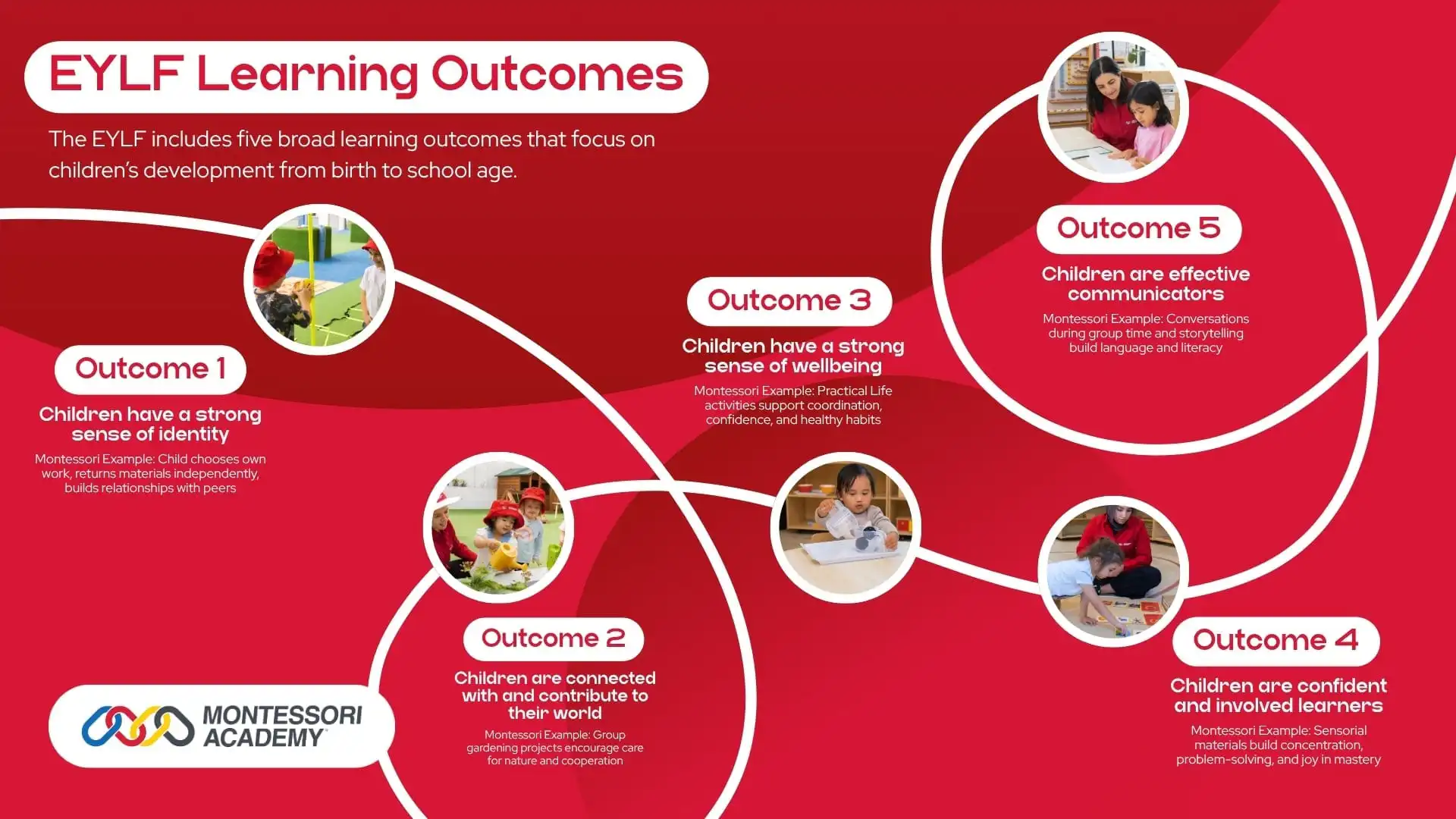
The 5 outcomes of EYLF are designed to support the whole child and guide educational practice in early childhood settings.
- Outcome 1: Children have a strong sense of identity
- Outcome 2: Children are connected with and contribute to their world
- Outcome 3: Children have a strong sense of wellbeing
- Outcome 4: Children are confident and involved learners
- Outcome 5: Children are effective communicators
These EYLF learning outcomes are not a checklist or test. Instead, they provide a framework educators use to support developmental progress through work and play, relationships, observation and meaningful experiences and interactions.
EYLF Outcome 1: Children Have a Strong Sense of Identity
EYLF Outcome 1 focuses on helping children feel safe, secure and confident in who they are. Through supportive relationships and positive interactions, children develop independence, resilience and a sense of belonging.
| Learning Outcome | Examples | Activities |
|---|---|---|
| 1.1 Children feel safe, secure and supported | “Care of self” Grace and Courtesy lessons enable children to develop skills to protect their own sense of safety and comfort | Through specific lessons of Grace and Courtesy children learn that when they select a material to work with, they can work with it until they are ‘done’. There is no requirement to ‘share’; they learn the language to indicate that they prefer to work alone, as well as how to invite someone to join them. |
| 1.2 Children develop their emerging autonomy, inter-dependence resilience and agency | Freedom to choose their own work/activity that has previously been presented and take responsibility for returning the activity on completion. | Practical life activities – these develop children’s self-help skills- such as spooning, tonging, sponging, sweeping and the dressing frames |
| 1.3 Children develop knowledgeable and confident self identities and a positive sense of self worth | Expressing preferences and supporting children to understand their place in the world through supporting language and culture from home | Cultural celebrations linked through the Geography materials – world and continent puzzle maps, continent picture cards, storytelling |
| 1.4 Children learn to interact In relation to others with care, empathy and respect | Montessori education prioritizes social-emotional development, whereby children learn how to interact positively and respectfully with others | Lessons of Grace and Courtesy are presented at group times through role plays and discussions. These systematically provide the tools for accepted social interactions, starting with the “Morning Greeting” at the classroom door. |
At Montessori Academy our environments support EYLF Outcome 1through carefully “prepared environments” that encourage choice, peer interaction, and personalized care, allowing children to build secure, autonomous identities. These experiences also support important developmental milestones during the preschool years.
Learn more about children’s developmental milestones and how they connect to early learning.
EYLF Outcome 2: Children Are Connected with and Contribute to Their World
EYLF Outcome 2 encourages children to understand relationships, respect diversity and contribute positively to their community and environment.
| Learning Outcome | Examples | Activities |
|---|---|---|
| 2.1 Children develop a sense of belonging to groups and communities and an understanding of the reciprocal rights and responsibilities as active and informed citizens | Participating in group experiences | Daily group times provide children the practise of responsibility to their community as they participate in focused learning experiences. Geography materials such as the continent globe, continent and Australia puzzle maps help develop their understanding of their place in the world. |
| 2.2 Children respond to diversity with respect | Learning about different cultures | Educators proactively explore cultures, heritage, backgrounds and traditions of children in the context of the class and community. |
| 2.3 Children become aware of fairness | Sharing and turn-taking | With only one of each material available children learn to wait their turn and understand the justice of resource sharing. By taking responsibility for the material they are using, returning it in order to the shelf they further demonstrate the fairness of sharing. |
| 2.4 Children become socially responsible and show respect for environment | Caring for the environment | Starts in the classroom with lessons like “how to carry a chair” – without bumping and scraping; ‘how to clean up a spill’ – so as not to inconvenience others. The Practical Life curriculum encourages responsibility and spontaneously assisting others when a mishap occurs. Leaf cleaning, watering plants, feeding animals as well as gardening and composting in the outdoor environment. |
Montessori education naturally aligns with EYLF Outcome 2 by fostering independence, respect for the environment, and social responsibility through Practical Life activities, community routines, and mixed-age classrooms.
In Montessori environments, children practise grace and courtesy daily, helping build social awareness and positive communication skills.
EYLF Outcome 3: Children Have a Strong Sense of Wellbeing
EYLF Outcome 3 supports children’s physical, emotional and mental wellbeing. It encourages healthy lifestyles, emotional regulation and physical confidence.
| Learning Outcome | Examples | Activities |
|---|---|---|
| 3.1 Children become strong in social, emotional and mental wellbeing | The Montessori concept of ‘freedom within limits’ allows for the autonomy of the child within a framework of clear expectations (established through the lessons of Grace and Courtesy) and classroom practices | Using a mat to create a workspace, walking around the mats, returning the materials to the shelf and not interrupting/touching another child’s work builds children’s capacity to collaborate and work together while building autonomy and responsibility as social contributors. |
| 3.2 Children become strong in their physical learning and wellbeing | Practising self-care routines | Lessons of Grace and Courtesy, including: ‘how to blow your nose’ ‘how to cough’ ‘how to wash your hands’. Dressing frames build self-care skill. |
| 3.3 children are aware of and develop strategies to support their own mental and physical health and personal safety | Montessori recognises that movement is integral 2 children’s development and the materials are arranged and utilised in a manner that promotes purposeful walking within the classroom | Starting with learning to carry a tray to a table (Practical life activities) 10 piece sensorial activities such as the Pink Tower, Brown Stair, Red Rods. |
Montessori education strongly aligns with EYLF Outcome 3 by fostering independence, emotional regulation, and physical competence through a “prepared environment”. Practical life activities develop fine motor skills and self-care, while child-led work promotes confidence and emotional security, directly meeting EYLF goals for holistic health.
EYLF Outcome 3 examples can include sensory play, outdoor movement and fine motor experiences. Many families ask which EYLF outcome is linked to sensory play — sensory experiences are strongly connected to Outcome 3 because they support emotional regulation, wellbeing and brain development. Montessori sensorial materials directly target sensory development while strengthening concentration and coordination.
EYLF Outcome 4: Children Are Confident and Involved Learners
EYLF Outcome 4 focuses on curiosity, creativity and problem-solving. Children learn through exploration, investigation and hands-on practice.
| Learning Outcome | Examples | Activities |
|---|---|---|
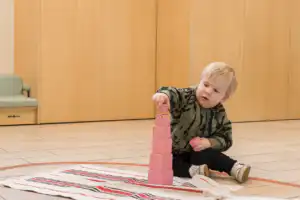
| 4.1 Children develop A growth mindset and learning dispositions such as curiosity, cooperation, confidence, creativity, commitment, enthusiasm, persistence, imagination and reflexivity for learning | Showing curiosity and persistence | Self-correcting nature of the materials allows for the children to repeatedly engage with the materials And to approach the challenge confidently, develop reflexivity and engage in problem solving independently without relying on an adult to assist – a favourite example for a younger child would be to build the Pink Tower in the correct order, for an older child to complete the Trinomial Cube. |
| 4.2 Children develop a range of learning and thinking skills and processes such as problem-solving skills, inquiry, experimentation, hypothesising, researching and investigating | Montessori materials are hands on learning materials presented to the child in a lesson – Across the curriculum the focus is on concepts such as sorting, matching, comparing, contrasting and cataloguing that assist the formation of organised thinking. | Following the initial presentation of a work the child will work with it till they have achieved mastery, at which point the educator will present extension activities for further exploration – combining the Pink Tower and Brown Stair. |
| 4.3 Children transfer and adapt what they have learned from one context to another | Applying previous knowledge | Montessori materials are arranged and presented from simple to complex. The material many of the materials link across multiple areas – the Red Rods to the Number Rods; The Pink Tower to the Bead cubes. Work with the Sandpaper Letters and I spy games builds knowledge of the sounds of the alphabet that are then utilised to build words with the Movable Alphabet. |
| 4.4 Children resource their own learning through connecting with people, place, technologies and natural and processed materials | Natural materials, from both nature and manufactured from natural sources fill the Montessori environment. These are the hands-on materials children explore as they discover abstract concepts made concrete. | Montessori Academy supports the thinking that children learn through sensory exploration and movement and follow Montessori’s aphorism never give more to the brain than the hand can hold – As such the primary focus for learning is with concrete materials and highly limited access to digital technologies |
Montessori education strongly supports EYLF Outcome 4 by fostering independence, concentration, and curiosity within a prepared environment. Children actively engage in hands-on, self-directed learning, using materials to problem-solve and explore, which builds confidence and persistence
In Montessori classrooms, educators carefully observe children’s interests and prepare environments that encourage independent discovery and purposeful learning.
EYLF Outcome 5: Children Are Effective Communicators
EYLF Outcome 5 supports verbal and non-verbal communication, literacy and self-expression.
| Learning Outcome | Examples | Activities |
|---|---|---|
| 5.1 Children interact verbally and non-verbally with others for a range of purposes | Using gestures and language confidently | Educators respond to children’s cues both verbal and non-verbal through thoughtful and focused use of correct names and descriptors. Group time Interactions and discussions, and programs like Music and Movement support a range of differing communication means. |
| 5.2 Children engage with texts and gain meaning from these texts | Developing early literacy skills | Books and other literature forms are featured across all classrooms. Reading experiences and storytelling are consistent daily practices. |
| 5.3 Children express ideas and make meaning using a range of media | Communicating through music and movement | Music, dance and dramatic play, enhanced through the Music and Movement program |
| 5.4 Children begin to understand how symbols and patterns systems work | Recognising letters and numbers | Montessori Sandpaper Number and Sandpaper Letters Other foundational materials 4 the mathematics and language curriculums. The children use multiple senses – touch, sight, hearing as they work with these materials, laying a foundation for future work. |
Montessori education aligns with EYLF Outcome 5 by fostering communication through independence, “grace and courtesy” lessons, and sensory-based language materials. Montessori children become effective communicators by developing rich vocabulary, exploring literacy through tactile materials (like sandpaper letters), and using oral language for social interaction and expressing ideas.
How Educators Use These Outcomes
Educators use the EYLF outcomes as a framework to guide curriculum planning, observation and assessment in childcare and preschool settings. The framework helps educators understand how children learn best through play, relationships, communication and hands-on experiences. It also supports consistent teaching practices across early childhood education environments in Australia.
Rather than using a strict checklist, educators observe how children learn during everyday experiences. These observations help educators create responsive programs that support individual interests, strengths and developmental needs. Through ongoing observation, documentation and reflection, educators can adapt learning experiences to encourage confidence, wellbeing, communication and problem-solving skills.
At Montessori Academy, educators carefully prepare learning environments that encourage independence, concentration and hands-on exploration. Experiences are thoughtfully designed to align with the National Quality Standard (NQS) while supporting each child’s developmental journey across all five EYLF learning outcomes. By combining the EYLF framework with Montessori principles, educators create meaningful opportunities for children to explore, practise new skills and develop at their own pace.
Documentation may include:
- Learning stories
- Observations
- Photos of play and practice
- Development summaries
- Communication with families
How to Support Your Child at Home to Achieve These Outcomes
Families play an important role in supporting EYLF learning outcomes at home. Everyday experiences can become valuable learning opportunities.
You can support your child by:
- Encouraging independent self-care routines
- Reading together daily
- Providing opportunities for art and creative play
- Involving children in cooking and gardening
- Supporting outdoor movement and physical wellbeing
- Encouraging conversations and problem-solving
- Creating routines that help children feel secure and confident
Simple experiences such as building friendships, creating a self-portrait, sorting colours or helping prepare meals all contribute to early childhood learning and development.
FAQs
What is the aim of EYLF Outcome 1?
The aim of EYLF Outcome 1 is to help children develop a strong sense of identity, belonging and emotional security.
Which EYLF outcome is linked to sensory play?
Sensory play is commonly linked to EYLF Outcome 3 because it supports wellbeing, emotional regulation and physical development.
What EYLF outcome is linked to cooking?
Cooking activities can support multiple EYLF outcomes, particularly Outcome 2, Outcome 3 and Outcome 4 through collaboration, wellbeing and problem-solving.
Is the EYLF only used in childcare?
No. The EYLF framework is used across a range of early childhood education settings, including childcare, preschool and kindergarten programs throughout Australia. You can explore the official EYLF v2.0 document published by ACECQA for a more detailed summary of the framework.
Are the EYLF outcomes a test?
No. The EYLF outcomes are not a test or checklist. They are a framework used to guide learning, observation and developmental support.
Supporting Every Step of Your Child’s Learning Journey
The EYLF outcomes are designed to celebrate the many ways children learn, grow and develop during early childhood. They are not about achieving perfection or meeting rigid targets. Instead, they provide a supportive framework that helps educators and families recognise the incredible learning happening every day through play, relationships, exploration and practice.
Every child develops at their own pace, and the EYLF helps educators respond to each child’s unique strengths, interests and developmental needs. Through thoughtful observation, meaningful interactions and carefully prepared learning environments, children are encouraged to build confidence, resilience and a lifelong love of learning. Whether they are developing communication skills, building friendships, exploring art or strengthening fine motor skills, each experience contributes to their overall growth and wellbeing.
At Montessori Academy, our educators combine the principles of the EYLF with the Montessori approach to create engaging learning experiences that nurture independence, curiosity and capability. By supporting children across all five EYLF learning outcomes, we help lay strong foundations for future learning while encouraging children to feel confident, capable and connected to the world around them.