The moment your child turns one, something shifts. Not just for them but for you, too. The baby who arrived needing everything done for them has become a person with opinions, preferences, a pointing finger, and very possibly a strong view on what goes in their mouth.
This first birthday marks one of the most rapid periods of human development that will ever occur. Between 12 and 24 months, your child’s brain is forming one million new neural connections every single second. They are not just growing. They are constructing themselves.
And here is what Maria Montessori understood over a century ago that research is still confirming today: children this age are not passive receivers of care. They are active, driven, deeply capable learners who absorb everything in their environment. The way you respond to their development right now matters far more than any toy, class, or program.
This guide covers what to expect from your 1 year old across every area of development, how the Montessori approach supports each milestone, and simple things you can do at home to help your child thrive.
In this article:
- What Are Developmental Milestones?
- Key Milestones from Birth to 12 Months at a Glance
- Developmental Milestones at 1 Year
- How the Montessori Approach Supports 1 Year Old Development
- Montessori Activities for 1 Year Olds at Home
- Signs Your One-Year-Old May Need Extra Support
- Frequently Asked Questions
What Are Developmental Milestones and How Should Parents Use Them?
Developmental milestones are skills or behaviours that most children can do by a certain age. They cover four key areas: physical development, language and communication, cognitive development, and social and emotional development. Understanding the typical stages of development from newborn through to the toddler years helps parents see how each new skill builds on the last.
Think of milestones as a map rather than a checklist. A map shows you the landscape and helps you know where you are. It does not tell you there is only one route, or that arriving slightly later than expected means something is wrong.
Every child develops at their own pace. Some one year olds are walking confidently by their birthday. Others take their first independent steps at 15 months and are running by 16. Both are within a completely normal range. What milestones do is help you notice if your child seems to be significantly behind across multiple areas over time, so you can talk to your paediatrician early if needed.
Key Milestones from Birth to 12 Months at a Glance
During your baby’s first year, every new skill lays the foundation for the next. The journey from newborn to active 12-month-old is extraordinary. The following chart provides a quick overview of the major developmental milestones babies commonly achieve across the first year of child development.
| Development Area | 0–3 Months | 3–6 Months | 6–9 Months | 9–12 Months |
|---|---|---|---|---|
| Physical | Lifts head, kicks legs, begins tummy time. | Rolls over, reaches for toys, sits with support. | Crawls, sits independently, pulls to stand. | Cruises, may take first steps, feeds themselves finger foods. |
| Fine Motor | Grasps objects briefly. | Transfers toys between hands. | Uses pincer grasp, bangs toys together. | Points, stacks blocks, attempts spoon feeding. |
| Cognitive | Tracks faces and objects. | Explores cause and effect. | Looks for hidden objects, understands object permanence. | Imitates actions, follows simple instructions, solves simple problems. |
| Language | Coos and responds to voices. | Babbles and laughs. | Copies sounds and gestures. | Says first words, points to communicate, understands familiar phrases. |
| Social & Emotional | Smiles at familiar faces. | Enjoys interaction and play. | Shows stranger awareness. | Seeks comfort from caregivers, imitates others, begins pretend play. |
As babies approach their first birthday, they become more mobile, communicative, and independent. These exciting 1 year old baby milestones often happen within a short period, making this one of the most rewarding stages of early toddler development.
Developmental Milestones at 1 Year
Physical Development Milestones at 12 Months
Physical development at 12 months divides into two areas: gross motor skills (the big movements) and fine motor skills (the precise, small movements). Both are developing rapidly right now, and both are driven by your child’s deep, instinctive need to move.
Gross Motor Skills
By around 12 months, most children can pull themselves up to standing using furniture, walk while holding onto furniture (a technique called cruising), and stand briefly without support. Many take a few independent steps, though some children do this closer to 14 or 15 months. By 18 months, most children are walking steadily and beginning to run, climb, and squat down to pick things up.
The Montessori view on this is direct: movement is not separate from learning. It is learning. Dr Montessori wrote that movement and cognition are deeply linked, and that restricting a child’s movement restricts their development. At this age, that means giving your child as much safe freedom to move as possible.
Fine Motor Skills
By 12 months, most children have developed a pincer grasp, picking up small objects between the thumb and index finger. You will see this every time they try to pick up peas at dinner. They can also bang objects together, put objects into containers and take them out again, drop and throw objects deliberately (yes, the spoon dropping from the highchair is intentional and developmental), turn pages of a board book, and begin using a spoon, though with significant mess. These small hand movements are the foundations of writing, drawing, and self-care skills that will develop over the next several years.
Cognitive Development Milestones at 12 Months
A one year old thinks like a scientist. They form a hypothesis (what happens if I drop this?), conduct an experiment (drop it), observe the result (it falls and you pick it up), and repeat the experiment until they have confirmed the finding (approximately forty-seven times). This is not misbehaviour. This is how the human brain learns cause and effect, one of the most important cognitive achievements of the first year.
By 12 months, most children understand object permanence, knowing that something still exists even when they cannot see it. This is why they now search for a toy you have hidden under a blanket, and why separation anxiety intensifies around this time. They also imitate actions and gestures they have observed, begin simple pretend play such as pretending to drink from an empty cup, recognise themselves in a mirror, and point to a familiar object or picture when it is named.
Maria Montessori called the period from birth to six years the Absorbent Mind, noting that children in this phase absorb everything in their environment with an effortlessness that no adult learning can replicate. At 12 months, this means your child is learning constantly, not just during “activity time.” They are learning from watching you cook, from listening to a conversation, from being carried through a garden and hearing you name the plants. Every ordinary moment is a cognitive event.
Language and Communication Milestones at 12 Months
Language development at 12 months divides into two streams, and both matter equally. Receptive language is what your child understands. Expressive language is what they say and communicate. At 12 months, your child’s receptive language is significantly ahead of their expressive language, meaning they understand far more than they can yet say.
By 12 months, most children say one to three words beyond “mama” and “dada,” respond to their own name consistently, follow simple one-step directions when paired with a gesture, understand the meaning of “no,” and point to things they want or find interesting. They also wave goodbye and use gestures like shaking their head or reaching up to communicate.
After 12 months, many children experience what researchers call a language explosion. Between 18 and 24 months, children typically acquire 8 to 12 new words per month. In a Montessori Infant Program, educators use proper, accurate language with young children rather than baby talk, because children’s brains at this age are absorbing everything they hear. At home, this means narrating your day in simple, real language: not “the birdie goes tweet tweet” but “look, there is a kookaburra.”
Social and Emotional Development at 12 Months
A 1 year old is experiencing emotions with full intensity and almost no capacity to regulate them. This is not a character flaw. It is neuroscience. The prefrontal cortex, the part of the brain responsible for emotional regulation, is not fully developed until the mid-20s. Your one year old is running on instinct, impulse, and the deep need for connection.
By 12 months, most children show clear preferences for familiar caregivers, experience stranger anxiety, express a range of emotions including joy, frustration, affection, and anger, and look to familiar adults for cues about how to react to new situations (a process called social referencing). They engage in simple back-and-forth play, begin to show empathy by noticing when others are distressed, and play alongside other children rather than with them — parallel play is completely developmentally appropriate at this age.
Montessori educators meet a child’s emotional world with the same respect they give a child’s intellectual world. Feelings are acknowledged, not dismissed. Dr Montessori observed that children develop inner security through consistency, calm, and feeling genuinely seen. At 12 months, this means predictable routines, warm responses to distress, and beginning the long, patient work of helping your child name what they feel: “You seem frustrated that the block isn’t fitting. That is hard.”
How the Montessori Approach Supports 1 Year Old Development
The Montessori approach to early learning is built on one central idea: the environment is the teacher.
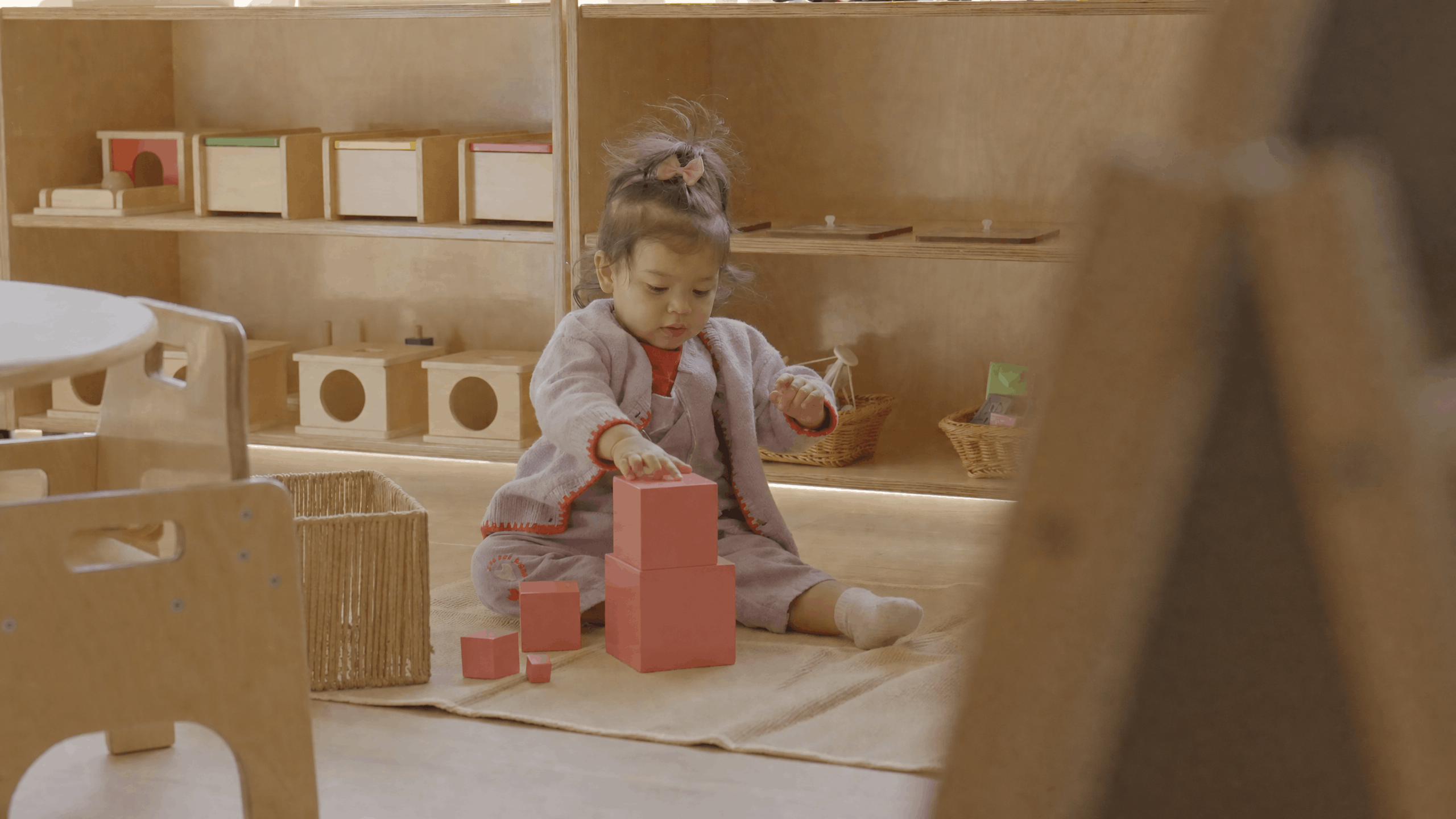
Rather than directing every activity or constantly intervening in play, Montessori encourages parents and educators to prepare an environment that supports the child’s natural drives: the drive to move, to touch, to explore, to repeat, and to do things independently. At 12 months, this looks like low shelves where a small number of materials are accessible without adult help, child-sized furniture, a floor space safe enough to explore freely, and real objects for real tasks such as a small dustpan, a dry pouring activity, a basket of objects with different textures.
During the first three years of life, children develop more rapidly than at any other time, absorbing large amounts of information from the environment through observation and experience. Getting the environment right at this age is not a luxury. It is one of the most important things a parent can do.
Montessori Activities for 1 Year Olds at Home
You do not need to buy anything special to support your 1 year old’s development the Montessori way. The most powerful activities at this age are simple, real, and purposeful.
Object permanence box. A small box with a hole where your child can drop a ball and watch it disappear, then find it in a drawer underneath. This directly supports the cognitive milestone of object permanence, and children at this age will return to it again and again.
Posting activities. Dropping large cardboard coin shapes into a slot cut in the lid of a container. Putting small objects into a bottle and shaking them out. These build fine motor skills and the deeply satisfying experience of cause and effect.
Water pouring. Two small jugs, a tray, and a little water. Pour from one jug to the other. Your child will spill. A lot. That is the point. Pouring builds hand-eye coordination, concentration, and the early foundations of independence.
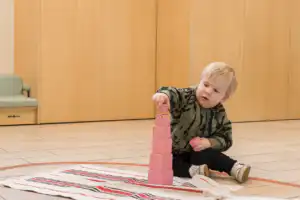
Stacking and nesting. Wooden blocks, nesting cups, or even Tupperware from the kitchen. Stack, knock down, repeat. This is cognitive and fine motor development happening in real time.
Practical life participation. At 12 months, your child wants to do what you do. Sweeping, wiping, carrying, stirring: all of these are Montessori practical life activities in the making. Give your child a real role in the household and they will take it seriously.
Reading together daily. Board books with clear, real photographs of objects are ideal at this age. Point to pictures, name what you see, pause and wait for your child to point too. This is 1 year old speech development in its most natural form.
Signs Your One-Year-Old May Need Extra Support
Milestones are guidelines, not guarantees. Every child has their own timeline. Some children walk at 10 months. Some do not take independent steps until 15 or 16 months. Both can be completely typical.
That said, there are some signs at 12 months that are worth discussing with your paediatrician. Consider this a 1 year old milestones red flags checklist — seek advice if your child is:
- Not pointing to objects or pictures to share interest with others
- Not looking at you when you speak or call their name
- Not babbling or attempting to communicate with sounds and gestures
- Not standing with support
- Not showing interest in simple back-and-forth games like peekaboo
- Losing skills they previously had, in any area
If something feels off, ask. Early conversation with your GP or child health nurse costs nothing and can make an enormous difference if extra support is needed. You know your child better than any checklist does. Trust that instinct.
Frequently Asked Questions About 1 Year Old Developmental Milestones
What are the key developmental milestones for a 1 year old?
By 12 months, most children can pull to standing, take a few steps with or without support, say one to three words beyond mama and dada, point to things of interest, follow simple one-step directions, wave goodbye, and engage in simple back-and-forth play. Cognitive milestones include searching for hidden objects, imitating actions, and beginning simple pretend play.
Is it normal if my 1 year old isn’t walking yet?
Yes. Most children take their first independent steps between 9 and 15 months, with some not walking independently until 16 or 17 months. Walking age has a wide normal range. If your child is not walking by 18 months, it is worth a conversation with your paediatrician, but walking at 13 or 14 months rather than 12 is not a cause for concern.
How many words should a 1 year old have?
Most 1 year olds say one to three words beyond mama and dada by their first birthday. By 18 months, most children have a vocabulary of 10 to 25 words. Every child’s language timeline is different, and receptive language (what they understand) is always ahead of expressive language (what they say) at this age.
How does the Montessori approach support 1 year old development?
Montessori supports 1 year old development by creating a prepared environment that invites independence, movement, and exploration. Low shelves with accessible materials, child-sized furniture, real objects for real tasks, and a calm consistent routine all support the rapid development happening in this period. The Montessori approach respects the child’s natural drives and trusts them to learn through purposeful activity rather than directed instruction.
What Montessori activities are best for 1 year olds?
Simple, purposeful activities work best. Object permanence boxes, posting activities, water pouring, stacking and nesting, practical life participation like sweeping or wiping, and reading together daily are all ideal. The key is to keep the environment simple and uncluttered, rotate materials regularly, and step back to allow your child to explore independently.
What is the Montessori view on developmental milestones?
Montessori education aligns closely with the research on developmental milestones, recognising that children develop at their own pace and that the environment plays a critical role in supporting natural development. Rather than pushing children to reach milestones faster, the Montessori approach focuses on creating the conditions in which each child’s development can unfold in its own time.
When should I be concerned about my 1 year old’s development?
Talk to your doctor if your 1 year old is not pointing or using gestures by 12 months, not babbling, not making eye contact, not standing with support, not searching for hidden objects, or if they have lost skills they previously had. Early conversations with a health professional are always worth having. The earlier a concern is identified, the more options are available.
How can I support my 1 year old’s development at home?
Talk and read to your child constantly. Name real objects in everyday situations. Create a safe, accessible space for free movement. Offer simple, purposeful activities over complex toys. Follow your child’s lead and observe what they are drawn to. Give them real tasks and real tools. And perhaps most importantly, slow down and let them do things themselves, even when it takes longer.
For detailed clinical guidance on what to expect at 12 months, the CDC’s developmental milestones resource is a helpful reference.