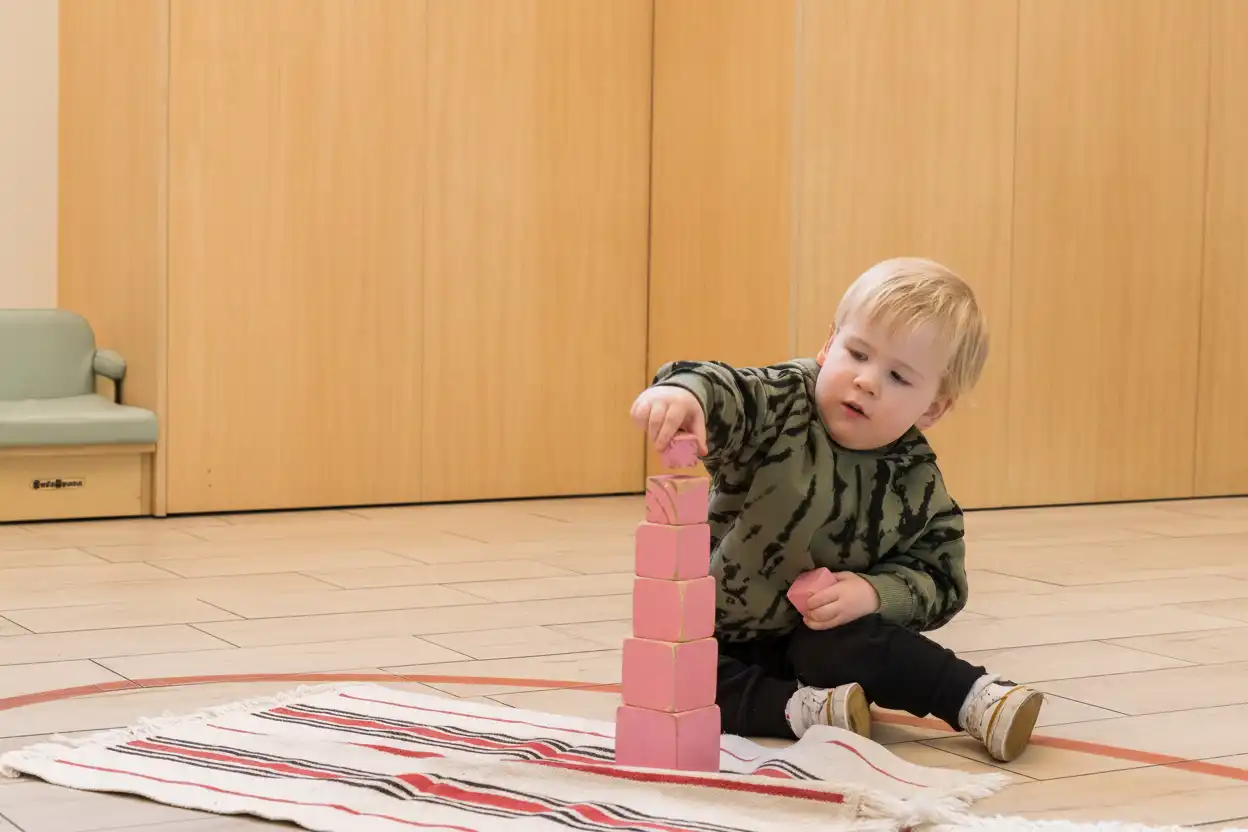
The Montessori Pink Tower is often called the symbol of Montessori, and it’s easy to see why. Ten simple pink cubes sit in Montessori classrooms all over the world, inviting children to carry, compare and build. This guide is for parents researching early learning options and for educators preparing for their own classroom. It explains what the Pink Tower is, the purpose behind it, how the lesson is presented, and how you can bring the same learning home with our free printable. It’s one of the best-loved Montessori Materials in our centres, and a favourite with children and educators alike.
What Is the Montessori Pink Tower?
The Pink Tower is a sensorial material from the Montessori Curriculum. It is made up of 10 pink wooden cubes that increase evenly in size, from 1 cm³ to 10 cm³. Each cube grows by one centimetre in length, width and height. Because volume increases by the power of three, the second cube equals 8 of the smallest cubes (2³), the third equals 27 (3³), and the largest equals 1,000 (10³).
The Pink Tower also indirectly introduces children to base ten and the decimal system. It is one of the most iconic Montessori sensorial materials, and it builds early mathematical thinking through size comparison and proportion. In our video demonstration below, we explore how the Pink Tower introduces the third dimension through the cube.
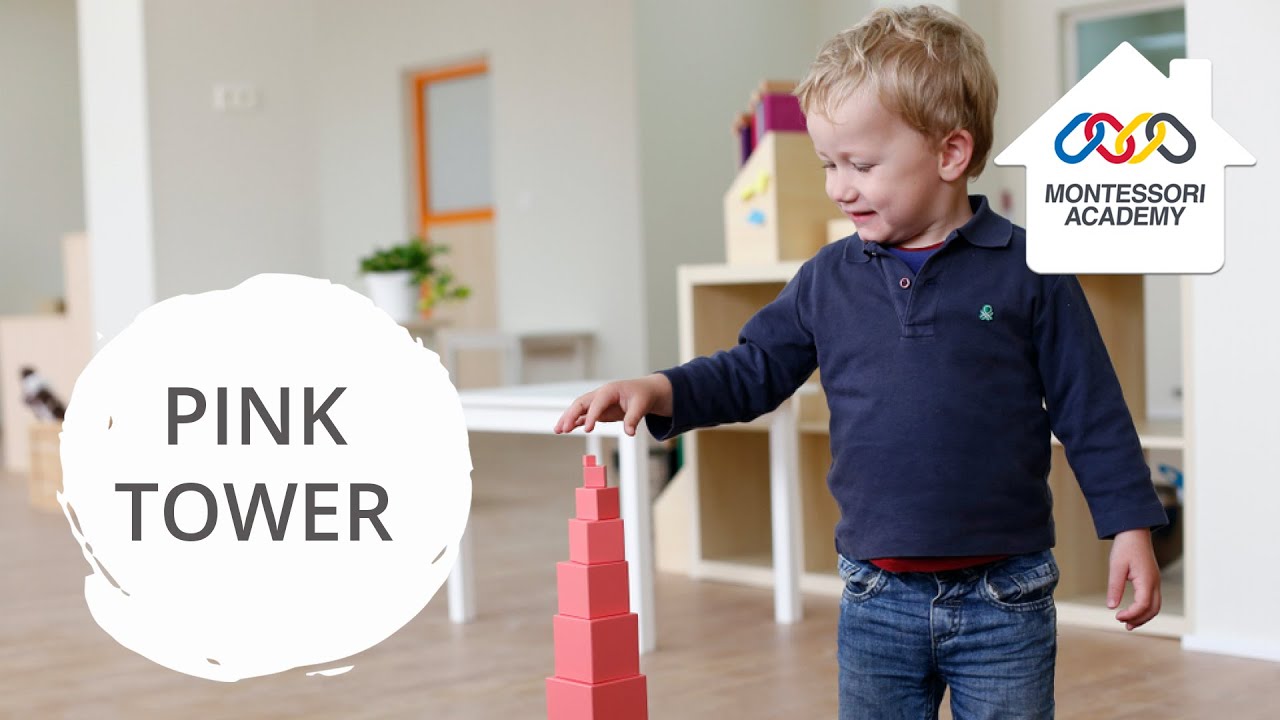
Why is it pink? Every cube is the same colour, texture and material, so size is the only thing that changes. This ‘isolation of a single quality’ lets the child focus on one concept at a time.
What Skills Does the Pink Tower Develop?
The Pink Tower is usually introduced when a child is around 2.5 to 3 years old. It reflects the Montessori philosophy that young children learn best through their senses and their hands. Its benefits include:
Visual discrimination of size. The child learns to see differences in size across three dimensions. This builds the awareness that later helps them describe objects as big, bigger and biggest.
Fine motor coordination. Carrying each cube and placing it precisely on the one below refines hand movements, grip and balance. The smallest cube, held between two fingertips, calls for real care.
Concentration and order. Building the tower is a complete cycle of work with a clear beginning and end. This helps a child sustain focus and enjoy finishing a task.
Indirect preparation for mathematics. The cubes lay a sensory foundation for later work with volume, the cube root and the decimal system, long before these ideas are taught abstractly.
Control of error. If a cube is placed out of order, the tower looks uneven or becomes unstable. The child can see the mistake and correct it without an adult stepping in, which builds independence and confidence.
How Is the Pink Tower Used in the Classroom?
In a Montessori presentation, the educator models the activity slowly and with few words, so the child can follow every movement.
- Roll out a mat as your workspace.
- Invite the child to the sensorial area and show them the Pink Tower.
- Starting from the top with the smallest cube, carry the cubes one at a time to the mat, with one hand on top and one underneath. Place them randomly on the mat.
- Once all the cubes are on the mat, sit next to the child’s dominant side.
- Begin building the Pink Tower by picking up the largest cube with the fingertips of each hand on either side.
- Pause from time to time to compare a cube with the next smallest one, to check that you have chosen correctly. Centre each cube, using a bird’s-eye view as your guide.
- When the tower is complete, check the centring again from above.
- Scatter the cubes again and offer the child a turn. They will make mistakes at first, but they will learn to judge size accurately with practice.
What Next?
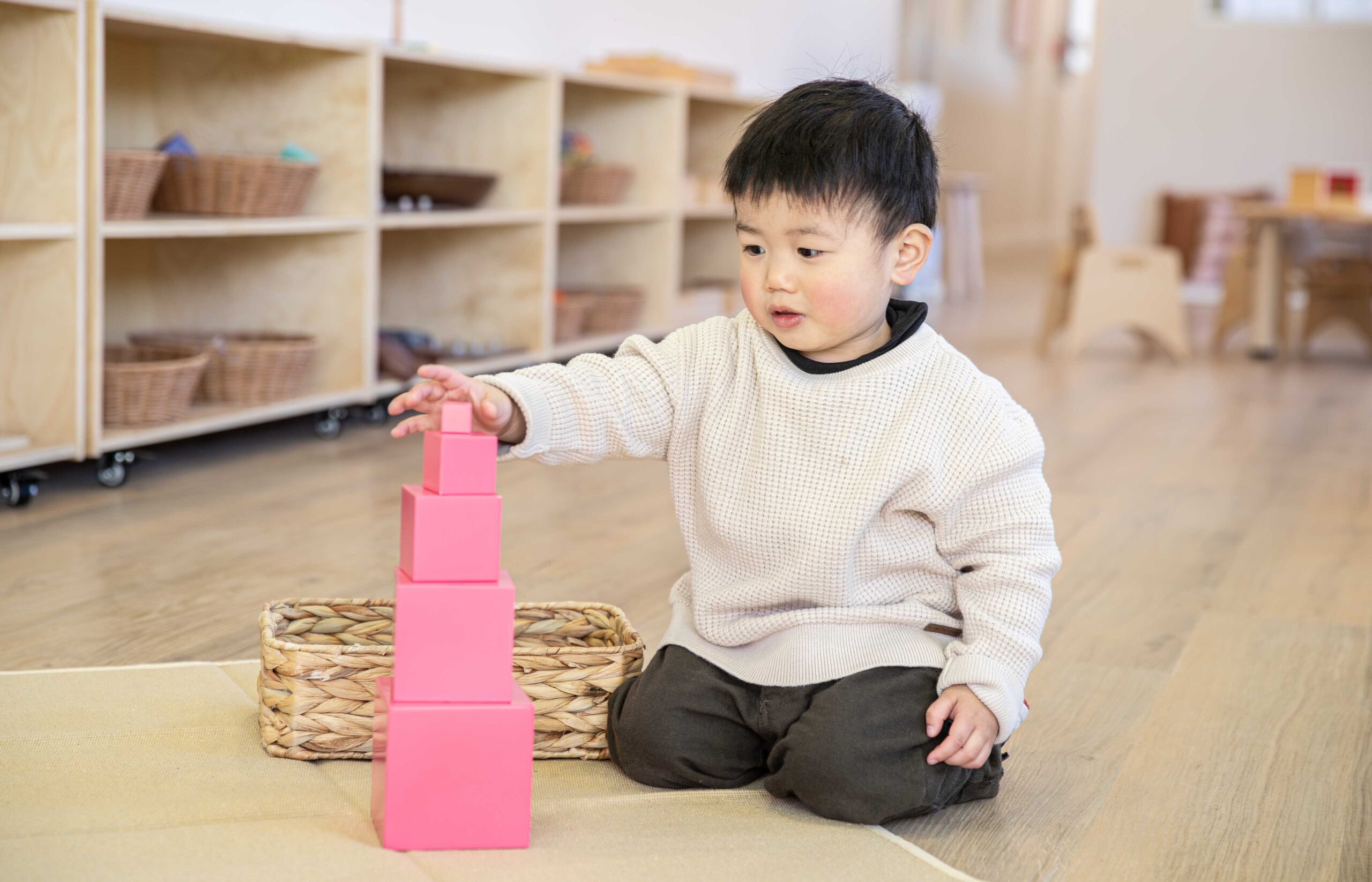
Once a child can build the tower confidently, they can move on to Pink Tower extensions. The most popular is combining the Montessori Pink Tower and Brown Stairs. The Brown Stair is a set of ten brown prisms. Each prism is the same length, and their square ends match the faces of the pink cubes. Children can build staircases, bridges and patterns that use both materials. This combination shows them that the two sets share the same dimensions.
Many classrooms also use Pink Tower extension cards. These cards show illustrations of different builds, such as a horizontal tower or a spiral, for the child to copy. Other extensions include building the tower at a distance from the cubes, so the child has to remember each size as they walk. Children can also use the tower in simple matching games with a friend.
How To Use the Montessori Pink Tower at Home With Printables
You don’t need a set of wooden cubes to explore the same ideas at home. Our free Pink Tower printable turns the material into a 2D activity for children aged 2 to 5. It contains ten pink squares that increase in size, in proportion to the faces of the original cubes. As your child handles the squares, they learn to scan, compare and order by size. This builds concentration, visual discrimination and a strong foundation for later maths and geometry.
Choose a quiet part of the day when your child is calm and focused. Encourage them to slow down and use both hands to place each piece carefully. You can store the cut-out squares in a small pouch or envelope, so your child can set up the activity independently.
Home Lesson 1: Seriation, Largest to Smallest
- Print and laminate the Pink Tower sheets. Cut out the 10 squares and place them in a container.
- Prepare your workspace with a small rug, towel or bath mat on the floor.
- Invite your child: ‘I have an activity to show you.’
- Place the squares randomly in front of you.
- Scan your hand over the squares and say, ‘I am looking for the biggest one.’
- Place the biggest square in the centre of the left side of your rug.
- Repeat step 5, placing the next square immediately to the right of the previous one and keeping it centred.
- Invite your child to continue until all 10 squares are placed from largest to smallest.
- Encourage your child to pack the activity away when they are finished.
This lesson supports independent thinking, and your child can self-correct through visual feedback.
Home Lesson 2: Seriation, Smallest to Largest
Repeat Home Lesson 1, this time starting with the smallest square. Reversing the order encourages your child to compare more carefully and think flexibly.
How the Pink Tower Connects to Later Learning
The Pink Tower may look like a simple stacking activity, but the skills it builds carry through into school readiness. Grading by size prepares children for sequencing numbers, and the careful hand control supports pencil grip and early writing. The habit of working with focus and order helps children settle into a classroom routine. Size vocabulary such as ‘large’, ‘larger’ and ‘largest’ also strengthens early language. This is how Montessori education works: concrete, hands-on experiences in the early years become the foundation for abstract learning later.
For a deeper look at the history and design of this material, the American Montessori Society has a detailed article on the Pink Tower and its place in Montessori pedagogy.
FAQs
What age is the Montessori Pink Tower for?
The Pink Tower is usually introduced at around 2.5 to 3 years of age. Children often keep returning to it, and to its extensions, until age 5 or 6.
What are the dimensions of the Pink Tower cubes?
There are 10 wooden cubes, ranging from 1 cm³ to 10 cm³, with each cube 1 cm larger than the last in every dimension.
What is the purpose of the Pink Tower in Montessori?
It develops visual discrimination of size, fine motor coordination and concentration. It also indirectly prepares children for mathematical concepts such as volume and the decimal system.
Can I use the Pink Tower at home?
Yes. Our free printable offers a 2D version with two simple lessons, so no wooden cubes are needed.