The Montessori Trinomial Cube – Math Preparation Resource
The Trinomial Cube is a traditional Montessori Material that prepares children for Mathematics and the Trinomial Equation. It is one of the most visually striking and engaging Montessori materials, often introduced in the preschool years to bridge sensorial learning and abstract thinking.
It also encourages left-to-right orientation, which supports early reading habits and visual tracking. The process of manipulating shapes and fitting them into place builds spatial reasoning, which is foundational for both geometry and early literacy. This introduces children to visual patterns and early algebraic thinking in a hands-on, age-appropriate way.
What is the Trinomial Cube?
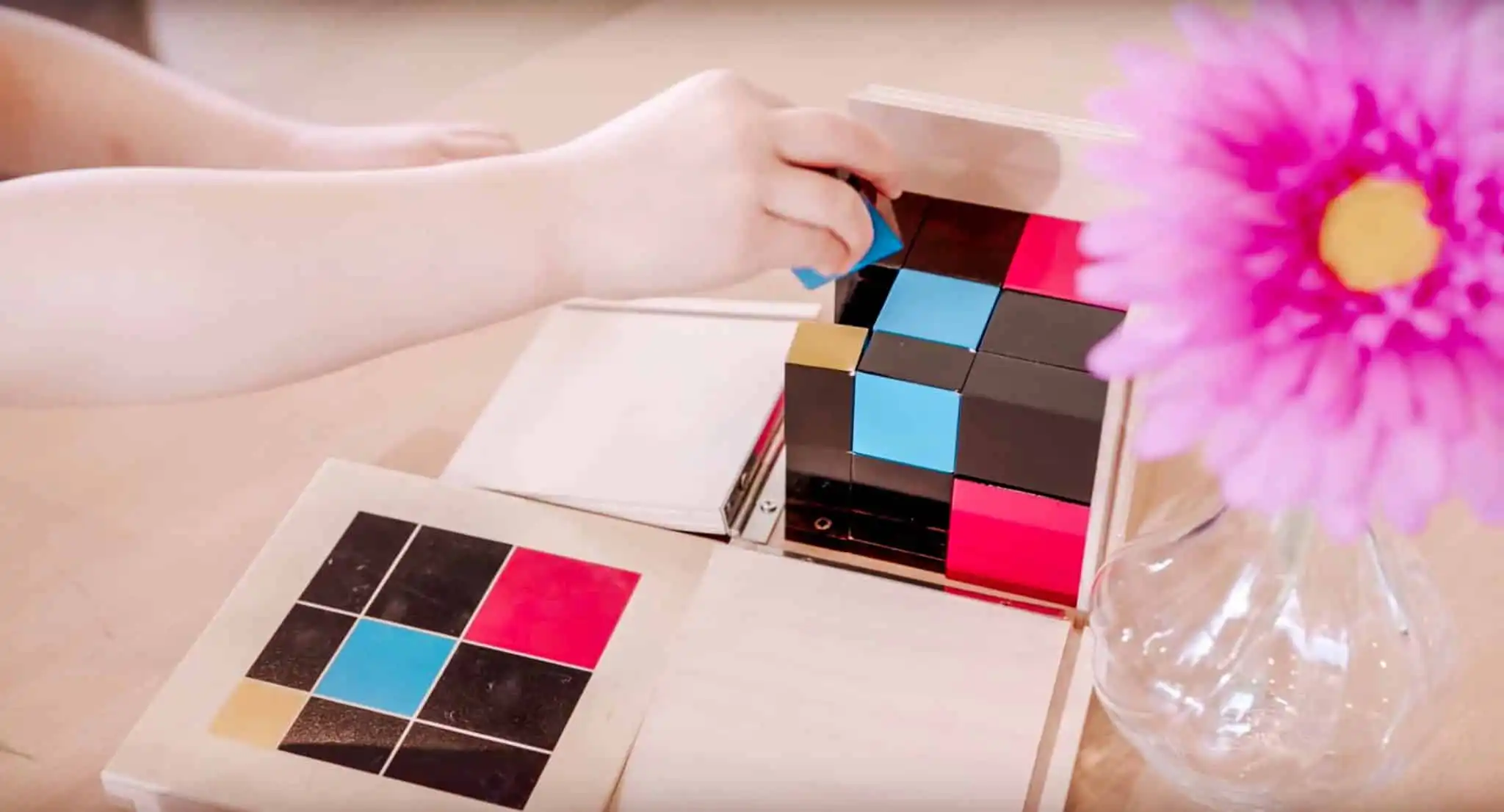
The Trinomial Cube is a wooden puzzle composed of 27 wooden blocks, each varying in size, colour, and shape. The goal is for children to reconstruct the cube using these blocks, arranging them in such a way that each face of the cube represents a trinomial equation. Through this hands-on activity, children engage in a multi-sensory exploration of mathematical concepts, spatial relationships, and geometric patterns.
How the Trinomial Cube Supports Early Learning
Developing Visual Discrimination
The purpose of this material is to help develop the child’s visual discrimination; particularly colour, pattern, and shape. As the child manipulates the cubes and prisms to form patterns and reconstruct the cube, they are engaging with the trinomial expression of (a+b+c)^3. This also indirectly prepares them for higher mathematics in later schooling.
Developing Spatial Awareness
One of the key benefits of the Trinomial Cube is its ability to enhance children’s spatial awareness. As they manipulate the wooden blocks and experiment with different arrangements, they develop a deep understanding of three-dimensional space. This tactile experience lays the foundation for more advanced concepts in geometry and mathematical reasoning, setting children on a path towards spatial literacy and problem-solving proficiency.
Fostering Logical Thinking
The Trinomial Cube also nurtures children’s logical thinking skills. As they work to reconstruct the cube, children must analyse patterns, identify relationships, and apply deductive reasoning to solve the puzzle. This process encourages cognitive flexibility and critical thinking, empowering children to approach challenges with confidence and creativity.
Encouraging Independence and Concentration
One of the hallmarks of Montessori education is the emphasis on independence and self-directed learning. Montessori materials are thoughtfully presented to children in a lesson, where after children are free to choose the activity and work on it as often as they like until they achieve mastery. The Trinomial Cube exemplifies the principles of child-led learning, as children are encouraged to explore the material at their own pace, free from external pressure or interference. This autonomy fosters a sense of confidence and self-reliance, while also promoting deep concentration and focus as children engage in meaningful exploration and discovery.
In our video demonstration, the educator introduces the Trinomial Cube puzzle as a first step toward understanding complex mathematical relationships. The printable version of the cube mirrors the visual pattern on the lid of the physical Trinomial Cube, which is found in Montessori classrooms.
Children begin by identifying and placing the largest cube first, then continue by building the spine with matching coloured squares and rectangles. This activity strengthens sequencing, spatial awareness, and concentration.
As your child gains familiarity, they will begin to notice how the colours and shapes relate to one another, supporting early problem-solving skills. You can support this by asking questions such as “What do you notice about this piece?” or “Where else do you see this colour?”
This printable puzzle can be used multiple times and is an excellent option for quiet work periods or indoor learning time. Laminating the pieces helps extend their durability and allows for continued use throughout the preschool years.
Home Lesson One
To practice this activity at home you can use the supplied print out to build one level of the cube as a 2D puzzle.
- Print and laminate the supplied printables including the control page and the cut-out page
- Lay out the control page
- Lay out the cut-out puzzle pieces randomly on the work space
- Locate the largest puzzle piece and build the spine using the coloured cubes
- Match the remaining rectangles to the correct position on the control sheet
- Reposition the puzzle pieces randomly on the table
- Invite your child to have a turn
Encourage your child to complete the activity slowly and carefully. Over time, they will begin to rely on their own observations rather than relying on prompts.
Supplied Printables
- Trinomial Cube Puzzle
This printable includes two pages: a control sheet for reference and a matching set of puzzle pieces. Children use these components to visually reconstruct the trinomial cube pattern, building confidence with colour matching and shape recognition.
Curriculum Area
- Mathematics
Age Group
- 3 – 6 years
Aims
- To build the cube
- Develop visual discrimination
- Develop fine motor skills
- Prepare children for mathematics
- Encourage independent problem-solving and pattern recognition
- Foster early confidence with structured, logical tasks