Numeracy in early childhood is about more than just numbers; it is the foundation of how a child understands the world. At Montessori Academy, we believe that every child is born with a “mathematical mind.” Long before a student enters a formal classroom to tackle addition or multiplication, they are already exploring the world through patterns, shapes, and sequences. By integrating these natural curiosities into our Montessori curriculum, we help children develop a lifelong love for learning and a strong foundational understanding of mathematical concepts.
Early childhood is a critical window for development. During these years, the brain is incredibly absorbent, forming millions of neural connections every second. When we introduce numeracy skills in a way that is tactile, fun, and pressure-free, we aren’t just teaching a child to count; we are helping them wire their brain for logical thinking and complex problem-solving.
What is numeracy in early childhood?
Numeracy is more than just reciting 1, 2, 3. In the early years, it is defined as the capacity, confidence, and disposition to use mathematical concepts in daily life.
- Recognising Symbols: Understanding that a written numeral (like “4”) represents a specific concept or amount.
- Understanding Quantities: Realising that numbers correspond to physical objects (e.g., four chairs at a table).
- Spatial Awareness: Seeing the relationship between objects, such as identifying that an orange slice is a semicircle.
- Problem Solving: Using mathematical thinking to navigate social or physical challenges, such as:
- Fairness: Sharing a snack equally among a group of friends.
- Estimation: Judging how many blocks are required to reach the top of a shelf.
- Logic: Developing the foundational “building blocks” for complex, abstract reasoning later in life.
Is numeracy just another word for maths?
While the two are closely linked, there is a subtle difference. “Maths” often refers to the formal study of numbers, operations, and theorems. Numeracy skills, however, are the practical application of those concepts. Essentially, numeracy is “maths in action.” It is the way a child uses their mathematical knowledge to solve problems, make decisions, and make sense of the world around them.
In a Montessori kindergarten or preschool setting, we focus on the foundational elements. We aren’t just teaching a student to pass a test; we are teaching a child to interpret the world. When a child understands that the number “5” represents five physical objects, they are moving from rote learning to true numeracy.
Numeracy in the Montessori Classroom
In the Montessori classroom, we move from the abstract to the concrete. We don’t ask children to simply memorise numbers on a page; we give them hands-on tools to feel the weight and quantity of what those numbers represent.
We use specialised hands-on learning materials used in Montessori that allow the child to correct their own mistakes, which builds a sense of independence and fun during the learning experience.
1. The Number Rods (Quantity)
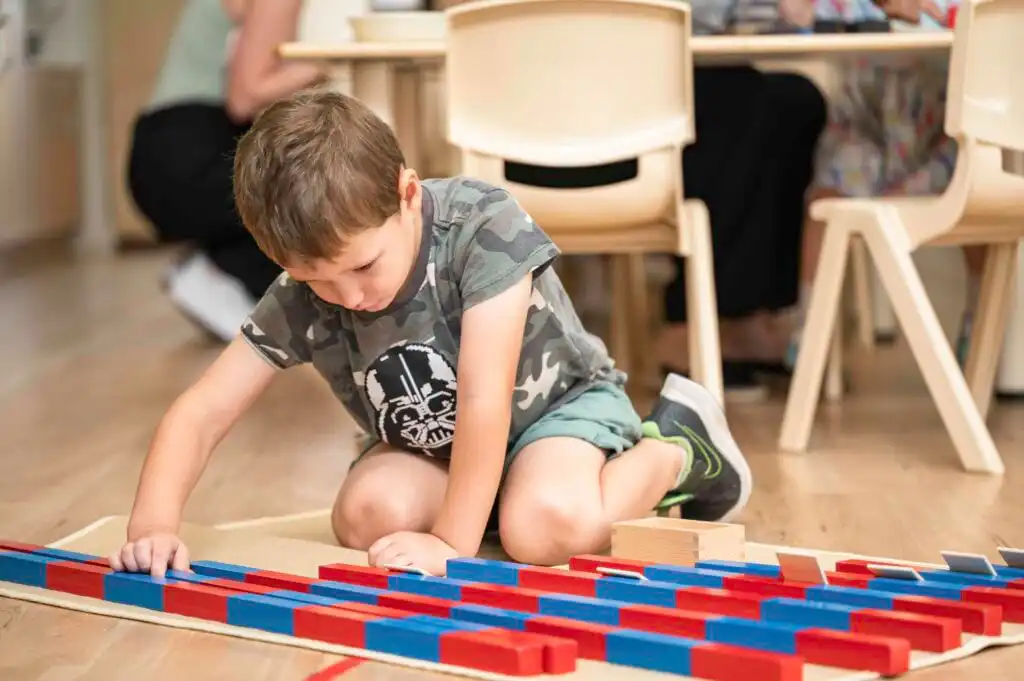
The Number Rods are ten wooden rods, varying in length from 10cm to 1 metre. Each rod is divided into red and blue sections. This is often a child’s first introduction to quantity.
- The Experience: Instead of seeing “1” and “2” as abstract symbols, the child sees that the “2” rod is physically twice as long as the “1” rod.
- The Goal: This provides a visual and physical development of the concept of length and quantity.
2. Sandpaper Numbers (Symbol)
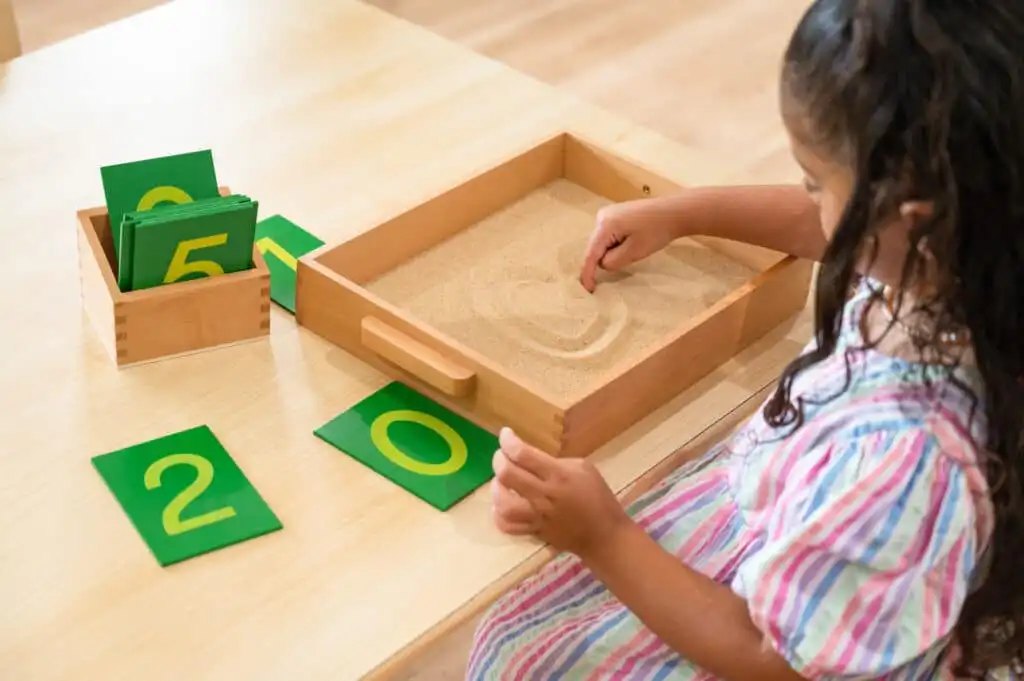
Before a child picks up a pencil to write, they use their senses. Sandpaper Numbers consist of wooden cards with numerals 0 to 9 cut out of sandpaper.
- The Experience: The child traces the number with their fingers, feeling the rough texture.
- The Goal: This builds muscular memory, linking the physical movement of the hand to the visual symbol of the number.
3. The Spindle Boxes (The Concept of Zero)
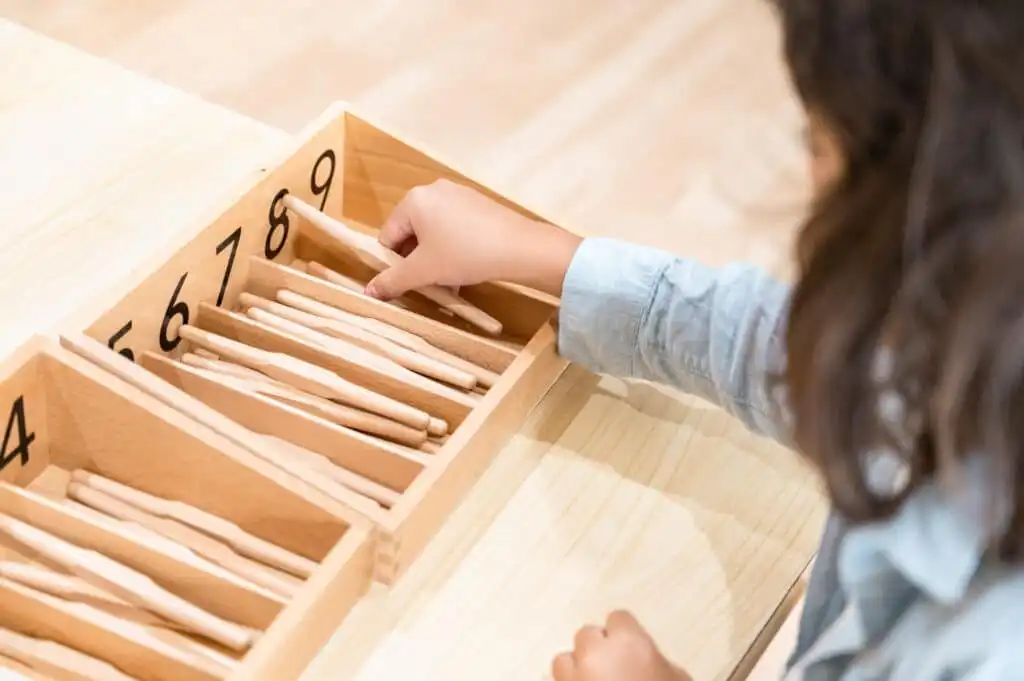
The Spindle Boxes consist of two wooden boxes with five compartments each, labelled 0 to 9.
- The Experience: The child must place the correct number of wooden spindles into each compartment. When they reach “0”, they find they have nothing to put in.
- The Goal: This introduces the concept of zero, the empty compartment, and reinforces that numbers represent separate units.
4. The Seguin Boards (Teen and Tens)
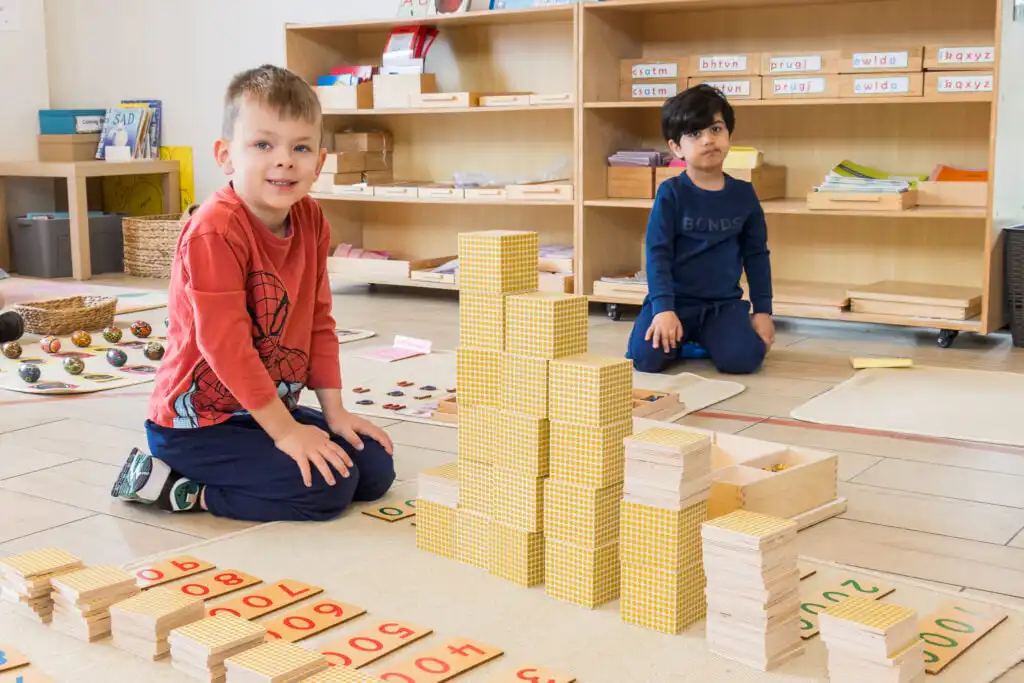
Once a child understands 1–10, we may introduce the Seguin Boards. These help children understand how “ten” and “one” make “eleven.”
- The Experience: A child slides a wooden card with the number “1” over the zero of the “10” on the board.
- The Goal: It visually demonstrates place value. The child sees that “11” is a ten and a one.
5. Golden Beads (The Decimal System)
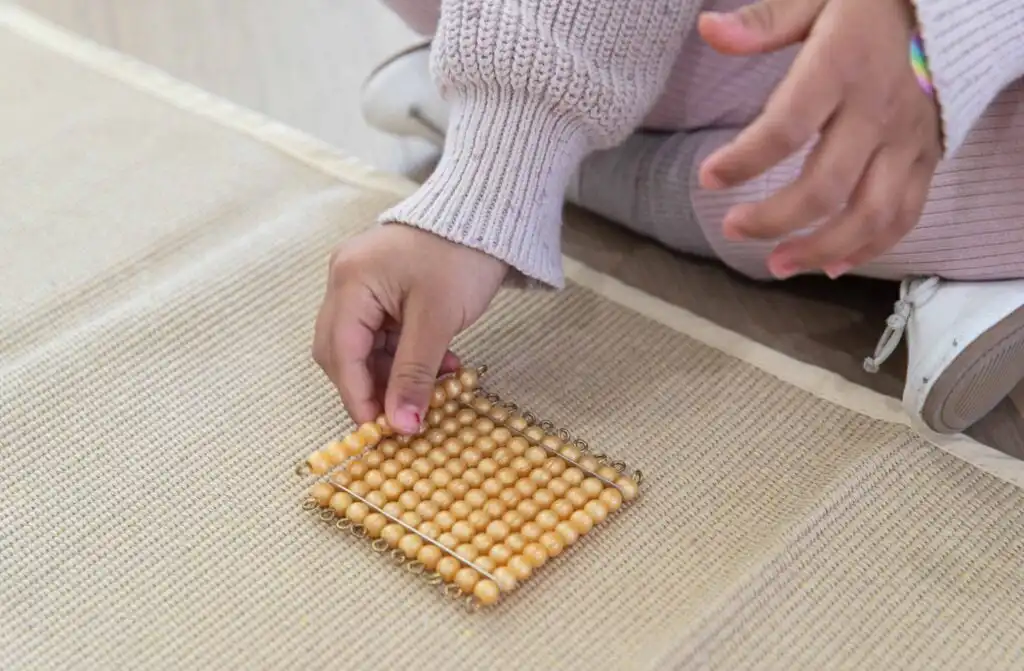
This is where addition, multiplication, and division begin. The Golden Beads represent units, tens, hundreds, and thousands.
- The Experience: A child can hold “one thousand” in their hands. They feel the weight and see the volume.
- The Goal: This tactile teaching method makes the decimal system intuitive and removes the mystery from large numbers.
Independence through the “Control of Error”
One of the most unique aspects of the Montessori experience is the “Control of Error” built into the materials. In a traditional early childhood education setting, a student often relies on a teaching adult to tell them if they have done a sum correctly. In our classrooms, the materials tell the child.
For example, in the Spindle Boxes, there are exactly 45 spindles. If a child miscounts and has one left over at the end, or doesn’t have enough to fill the last compartment, they immediately know a mistake was made. They don’t feel “wrong”; they feel curious. They go back, recount, and solve the problem independently. This builds an incredible sense of maths confidence and self-reliance that lasts a lifetime.
Aligning with the EYLF Outcomes
Our program is designed to meet the standards set by the Early Years Learning Framework (EYLF) V2.0. Numeracy is woven through several key outcomes:
Outcome 4: Confident and Involved Learners
Children develop skills such as problem-solving and experimentation. When a child uses Montessori materials, they are engaging in active education.
- Mathematical Thinking: Children use trial and error to see how shapes fit together.
- Persistence: Completing a complex counting task builds emotional resilience.
Outcome 5: Effective Communicators
Children demonstrate an increasing understanding of measurement and number symbols. Numeracy is a language. By learning the “vocabulary” of numbers, children gain a new way to communicate their observations to their peers and teaching staff in the classroom.
Why is numeracy important in early childhood?
Research shows that early numeracy skills are one of the strongest predictors of later academic success. Beyond the classroom, developing these skills supports:
- Cognitive Development: Enhancing memory and spatial awareness.
- Confidence: Empowering children to approach challenges with a “can-do” attitude.
- Communication: Helping children describe their environment accurately.
- Life Skills: Understanding time and measurement are essential for independence.
By understanding how children learn through play, we see that numeracy is a vital part of a child’s social development.
The “Sensitive Period” for Mathematics
Dr Maria Montessori identified “Sensitive Periods”, times when a child is primed to learn a specific skill. Between 3 and 6, most children enter a sensitive period for numbers and order.
During this time, a child is naturally drawn to categorising and counting. If we provide the right activities during this window, child can learn these concept with joy. This is why our Montessori education prioritises early exposure.
Numeracy Activities for Preschoolers and Toddlers
You can easily replicate the Montessori spirit and principles at home. The key is to keep it fun and practical.
In the Kitchen
- Setting the Table: “We have four people for dinner. How many forks do we need?” This is a direct application of one-to-one correspondence.
- Baking and Measuring: Using measuring cups introduces fractions and volume. It’s a practical life activity with a delicious reward!
In the Garden
- Nature Patterns: Collect leaves and stones. Encourage your child to create a pattern (e.g., leaf, stone, leaf, stone).
- Growth Tracking: Measure how high a sunflower has grown each week using a ribbon or a ruler.
In the Bedroom
- Sorting Laundry: Ask your toddler to find all the “small” socks and all the “big” socks. This introduces size and categorisation.
- Toy Tally: Before bed, count how many stuffed animals are being tucked in.
For more inspiration, you can find more hands-on activity ideas for toddlers that focus on sensory and mathematical exploration.
Numeracy Milestones: A Guide for Parents
While every child develops at their own pace, here is a general guide to numeracy early childhood milestones:
| Age Group | Typical Numeracy Skills |
|---|---|
| 0–2 Years | Identifying “more” or “gone,” and noticing patterns in daily routines. |
| 2–3 Years | Counting to five (often skipping numbers) and recognising basic shapes. |
| 3–4 Years | Counting to ten and beginning to understand the concept of “sharing.” |
| 4–5 Years | Identifying numerals 1–20 and simple addition using objects. |
The Importance of Spatial Awareness
Numeracy isn’t just about numbers; it’s also about space. At Montessori Academy, we use Geometric Solids (spheres, cubes, cylinders) to help children understand the three-dimensional world.
When a child plays with these shapes, they are learning:
- Perspective: How a shape looks from different angles.
- Geometry: The names of shapes like an “ellipsoid.”
- Physics: Which shapes roll and which shapes stack.
These numeracy activities for preschool or kindergarten age children build the spatial reasoning required for later success in engineering and science.
Tips for Parents: Building a Positive Maths Culture
Many adults feel “maths anxiety,” but it’s important to ensure this isn’t passed on.
- Be Positive: Avoid saying “I was never good at maths.” Frame activities as a puzzle.
- Use Mathematical Language: Use words like heavy, light, tall, short, total, and equal.
- Play Games: Board games with dice are incredible for numeracy skills for preschoolers as they require subitising (recognising the number of dots without counting them).
Exploring the “Language of Maths”
In a Montessori setting, we perceive that “Maths is a language.” Just as children learn the sounds of letters before they read words and sentences, they are first introduced to the “sounds” of quantity before working with numbers and equations. Through hands-on materials, children come to understand what numbers represent, not just what they look like on paper. This foundation allows maths to develop naturally, in the same way spoken language grows from meaningful experiences.
When a child works with multiplication using the Bead Chains, they are not simply memorising facts or reciting tables. They physically build the chain, count the beads, and observe how each repetition adds length. The growth of the chain makes the concept of multiplication clear and concrete.
This visibility changes how children feel about maths. When they can see the logic and follow the pattern for themselves, the subject feels approachable and predictable. There is no need for guesswork or fear of being wrong because the materials provide clarity and feedback.
Supporting Every Kind of Learner
Every student has a unique learning style. The Montessori method is multimodal, meaning it supports:
- Visual Learners: Through the brightly coloured beads and clearly defined rods.
- Kinaesthetic Learners: Through the constant movement and handling of wooden materials.
- Auditory Learners: Through the rhythmic counting and verbal lessons shared by the teaching staff.
By catering to all senses, we ensure that no child is left out in their mathematical development.
Our goal is to foster a sense of wonder in every child. We believe that when a child is given the right environment and the right materials, they don’t just “learn” maths, they discover it. The Montessori education method is designed to respect the individual rhythm of every student, ensuring they never feel rushed. By building these foundational skills early, we set our students up for a future where they feel capable and confident in their abilities.
If you would like to see our program in action, we invite you to find a childcare near you and book a tour. You can see first-hand how our educators use the Montessori method to turn everyday moments into extraordinary learning opportunities.
Frequently Asked Questions (FAQs)
What is the “meaning of numeracy” in the EYLF?
In the EYLF, numeracy is defined as the capacity and confidence to use mathematics in daily life. It’s about having the “mathematical toolkit” to navigate the world.
Why is numeracy important in early childhood compared to later years?
In early childhood, children are in a “concrete” stage. They need to touch quantities. If they develop a strong mental image of “ten” now, abstract maths in high school will be much easier.
Why is literacy and numeracy important in early childhood?
Both are the “keys to the kingdom” of learning. Literacy allows children to share ideas, while numeracy allows them to quantify those ideas. Together, they form the bedrock of a child’s ability to succeed in future schooling.
How does Montessori teach multiplication and addition?
We use the “Golden Bead” material. Addition is “putting quantities together,” and multiplication is “adding the same quantity multiple times.” This makes the concept a physical experience rather than a mental strain.
What are some numeracy activities for kindergarten at home?
Try “Grocery Store Math.” Ask your child to find the “cheapest” cereal or to find “three green apples.” This introduces price and weight in a real-world setting.
Is my child too young for maths?
Never! If a child can notice they have two hands, they are engaging with mathematical concepts. The Montessori teaching style ensures we follow the child’s interest, making the experience age-appropriate and fun.
Note: This article was prepared to provide a comprehensive look at the numeracy journey within our centres. For more information on our practical life activities, please visit our parent resource section.