The Difference Between Montessori and Reggio Emilia Explained
When families compare Reggio Emilia vs Montessori, they are often choosing between two respected approaches to early childhood education that prioritise the child as an active participant in learning. Both philosophies value curiosity, respect, and meaningful engagement, yet they differ in how learning is structured, how educators guide children, and how classrooms are designed.
In addition, these approaches reflect distinct educational philosophies that influence not only what children learn but also how they experience learning every day. Montessori education emphasises independence, self-discipline, and mastery of practical and academic skills, allowing children to progress at their own pace through carefully designed materials. Reggio Emilia, on the other hand, encourages collaborative exploration, creative expression, and project-based inquiry, highlighting the role of relationships and community in shaping knowledge.
The Montessori approach was developed in the early 1900s by Maria Montessori, an Italian physician whose scientific observations of children shaped what is now known as the Montessori education philosophy. Her work emphasised independence, hands-on learning, and carefully prepared environments that allow children to progress at their own pace. These foundations are clearly outlined in Montessori Academy’s explanation of the Montessori Approach To Education, which focuses on respect for the child and purposeful learning.
The Reggio Emilia approach emerged after World War II in the Italian city of Reggio Emilia, led by educator Loris Malaguzzi. Rooted in community collaboration, the Reggio Emilia philosophy centres on creativity, expression, and project-based learning driven by children’s interests.
Understanding the similarities and differences between Reggio Emilia and Montessori helps families make informed decisions about which preschool approach best aligns with their values and their child’s learning style.
The Shared Foundations of Montessori and Reggio Emilia
CWhile discussions about Montessori vs Reggio Emilia often focus on differences, both approaches share several foundational principles that distinguish them from more traditional early childhood models.
Children Are Seen as Capable and Competent
Both philosophies are built on the belief that children are capable learners. In a Montessori classroom and in a Reggio Emilia learning environment, children are encouraged to explore, ask questions, and construct knowledge through experience rather than direct instruction.
Educators observe carefully and respond intentionally, allowing learning to unfold in ways that respect each child’s development. This shared respect for the child is central to both the Montessori philosophy and the Reggio Emilia philosophy.
The Learning Environment Supports Learning
The physical environment plays an essential role in both approaches, although it is expressed differently.
- In Montessori education, the Montessori prepared environment is orderly, calm, and carefully structured. The classroom layout is designed so children can move independently and access materials with confidence.
- In the Reggio Emilia environment, spaces are flexible and evolving. The classroom environment in the Reggio Emilia approach often reflects children’s ongoing projects and encourages collaboration, creativity, and dialogue.
Both recognise that children learn best in environments that are intentional and responsive, whether that is through a prepared Montessori space or a dynamic Reggio Emilia learning environment.
Learning Is Child-Led
Families often ask whether Reggio Emilia is similar to Montessori. In many ways, it is.
Both approaches prioritise child-led learning:
- Montessori learning allows children to choose purposeful Montessori activities within a structured framework.
- Reggio Emilia learning is guided by children’s interests and explored through collaborative projects.
These Montessori and Reggio Emilia similarities reflect a shared commitment to honouring how children naturally learn during early childhood.
Montessori vs Reggio Emilia: Key Differences
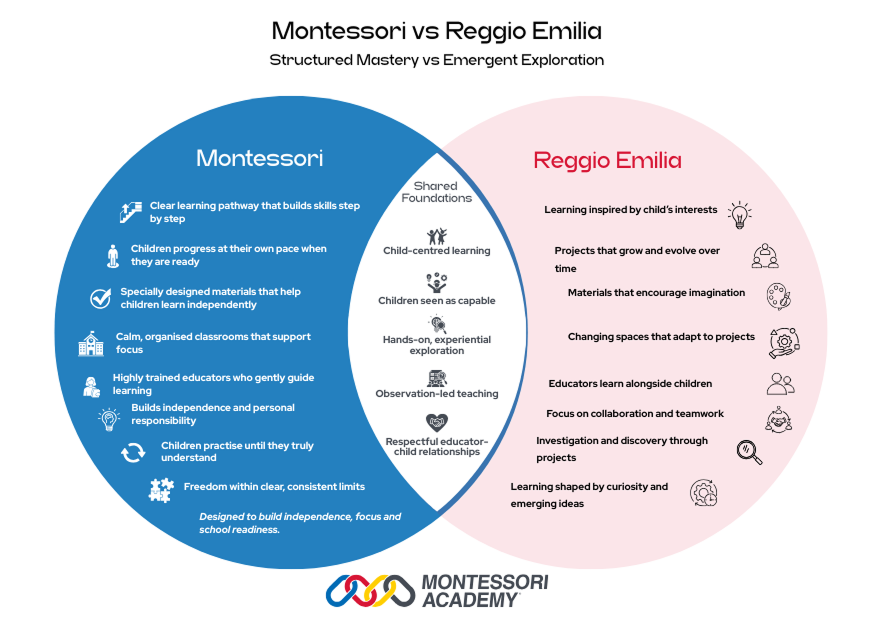
Although there are many similarities between Montessori and Reggio Emilia, there are also clear distinctions that influence how each approach looks in practice.
A Clear Comparison Table
| Area | Montessori Approach | Reggio Emilia Approach |
| Origins | Developed by Maria Montessori | Developed by Loris Malaguzzi and the community |
| Curriculum | Structured and sequential Montessori curriculum | Emergent and project-based |
| Materials | Purpose-designed Montessori materials | Open-ended and creative resources |
| Educator Role | Guide and observer | Co-learner and collaborator |
| Classroom Layout | Ordered and individual-focused | Flexible and collaborative |
| Assessment | Individual progress and mastery | Documentation and group reflection |
Philosophy and Structure
CriticaThe Montessori philosophy of education is grounded in scientific observation and developmental psychology. The Maria Montessori method emphasises independence, repetition, and mastery. Children work with specific materials designed to isolate skills, building confidence through practice.
In contrast, the Reggio Emilia philosophy places strong emphasis on collaboration, expression, and relationships. Comparing Reggio Emilia philosophy vs Montessori shows that Montessori follows a defined progression, while Reggio learning emerges from children’s interests and questions.
How Learning Happens
Meaningful critical reflection is purposeful, honest, and informed. It requires educators to move beyond surface-level observations and actively engage with why practices What is Montessori learning?
Montessori learning involves hands-on, self-directed activities that support concentration and independence. The Montessori learning environment is calm and structured, allowing children to focus deeply on their chosen work.
What is the Reggio Emilia approach?
The Reggio Emilia learning theory is based on the idea that children express understanding in many ways, such as drawing, building, storytelling, and movement. Reggio Emilia approach often includes long-term group projects rather than individual skill mastery.
The main difference between Montessori and Reggio Emilia is structure versus emergence. Montessori provides a clear developmental path while Reggio learning is fluid and responsive.
Which One Is Right for Your Family?
As part of effective reflective practice, educators use intentional questions to guide thinking and discussion. These questions may be explored through daily reflection, Choosing between Montessori vs Reggio Emilia depends on what kind of learning environment you value for your child.
The Reggio Emilia approach places strong emphasis on collaboration, creativity, and community involvement. The Reggio Emilia learning environment adapt continuously to reflect children’s interests and group investigations.
The Montessori approach to education offers a structured pathway that supports independence from an early age. In a Montessori classroom, children learn to manage their time, make choices, and develop self-discipline within a supportive framework.
Families exploring Montessori education often appreciate the consistency and clarity of the approach. Montessori Academy also provides detailed insight into Montessori materials and how children progress through the Montessori curriculum.
Many families choose Montessori Childcare at Montessori Academy because it combines structure, freedom, and independence in a way that supports long-term learning.
Why Parents Love the Montessori Approach
Educators engOne of the most significant differences between Montessori and Reggio Emilia is the emphasis on independence.
In Montessori settings, the child is the central focus. Educators carefully prepare the Montessori environment with specifically organised materials, defined learning areas, and clear routines. These environments are designed to encourage exploration while supporting self-directed learning. Teachers observe quietly, offering guidance only when necessary, allowing children to take ownership of their learning and develop problem-solving skills at their own pace.
The Montessori philosophy highlights freedom within limits. Children are encouraged to select activities that interest them from the Montessori prepared environment, engage with them if they choose, and repeat them until mastery is achieved. This approach fosters not only practical and cognitive skills but also a sense of responsibility, persistence, and intrinsic motivation. Guided by their sensitive periods (children’s interests in Montessori) and their engagement with the scientifically designed didactic materials the children teach themselves. They become autonomous independent learners.
Beyond individual tasks, independence in Montessori extends to everyday life skills. Children are guided to care for themselves and their environment, pouring their own drinks, setting tables, or tidying up classroom materials, which builds confidence and practical competence. This level of self-reliance contrasts with other educational models where adults lead most tasks, and it helps children develop a sense of agency that supports both academic and personal growth.
Parents often value that the Montessori education philosophy supports:
- Independence and responsibility
- Focus and concentration
- Respect for others and the environment
- A calm and purposeful classroom layout
If these approaches were mapped in a Montessori, Reggio and Waldorf Venn diagram, Montessori would stand out for its structured progression and carefully designed materials that support lifelong learning habits.
Supporting Your Child’s Early Learning Journey
When comparing Reggio Emilia vs Montessori, both approaches offer thoughtful, child-centred alternatives to traditional early childhood education, moving away from rigid, teacher-led methods and prioritising the child’s active participation.
The Reggio Emilia approach places strong emphasis on self-expression. Children are encouraged to investigate topics that interest them, often working in small groups to explore ideas through art, storytelling, construction, and dialogue. The learning process is seen as a collaborative journey where both children and educators contribute to understanding, and the classroom becomes a dynamic space that evolves alongside their projects. Community involvement is also central, with parents, local resources, and the wider environment often integrated into the learning experience.
The Montessori approach, by contrast, provides a carefully prepared learning environment that fosters independence, confidence, and mastery. The Montessori model is a holistic educational approach that nurtures students’ creative development.
Every activity, material, and classroom arrangement is intentional, designed to allow children to explore at their own pace and develop practical, cognitive, and social skills. From pouring water to solving complex problems with hands-on materials, children gradually gain competence while exercising choice, responsibility, and self-discipline.
Understanding the similarities between Reggio Emilia and Montessori, along with the differences between Montessori and Reggio Emilia, empowers families to make informed decisions about their child’s early learning journey. Considering factors such as your child’s learning style, temperament, and social preferences, as well as your family’s values and educational goals, can help determine which approach will best support your child in developing both academic skills and life-long love for learning.
For further reading, you may explore:
At Montessori Academy, we are proud to offer a nurturing Montessori learning environment that supports children to grow into capable, confident learners throughout early childhood and the preschool years. Beyond academic development, our approach fosters social and emotional growth, encouraging children to collaborate with peers, develop empathy, and build strong communication skills. The thoughtfully prepared classrooms, combined with engaging Montessori activities, allow children to explore their interests while developing independence and problem-solving abilities. This holistic focus ensures that each child leaves our care with a solid foundation for lifelong learning, curiosity, and self-confidence.