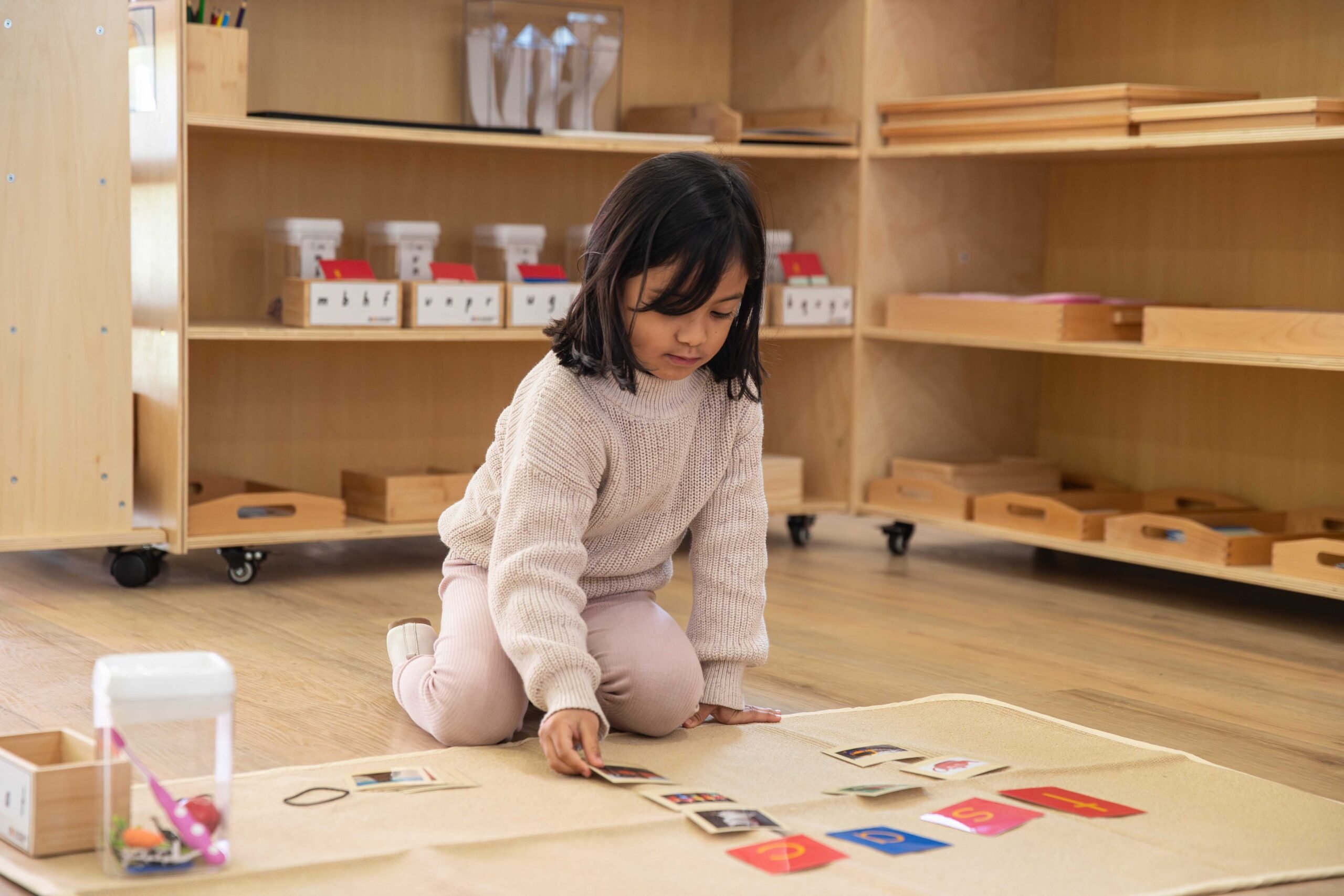
Hands on learning is an educational approach where children learn by doing, using their physical senses to explore and master new concepts. In a Montessori environment, this is often described as experiential learning, where the child is an active participant rather than a passive observer. By engaging in a tactile activity, children bridge the gap between abstract ideas and concrete reality, which is why a hands-on approach to learning theory is the foundation of Montessori education.
What is hands on learning?
Hands on learning is a method of instruction where students interact directly with materials, tools, or the natural environment to gain practical knowledge and cognitive skills. Instead of simply memorising facts from a book or listening to a teacher’s dialogue, a student or child in a hands-on learning program uses their body and mind in unison to manipulate objects, conduct experiments, and solve real-world problems.
The hands-on learning meaning is deeply rooted in Maria Montessori’s belief that the hand is the instrument of intelligence. When a child in a preschool or kindergarten setting physically touches a piece of equipment, such as tracing sandpaper letters to learn phonics or feeling the weight of different wooden blocks, they are creating a multi-sensory map in their brain. This makes the experience far more memorable, engaging, and fun than traditional rote learning.
What does it look like?
In a Montessori classroom, hands-on learning is visible in every corner of the room. It is not aimless play; rather, it is structured, purposeful, and self-directed. Here are the key aspects that define this approach:
- The Prepared Environment: Every activity is laid out in a logical sequence on low, accessible shelves. This invites the child to engage in work that matches their specific developmental stage.
- Concrete to Abstract Progression: Children first work with physical objects to understand a concept (like using the Golden Beads for math) before they are ever asked to solve an equation on paper.
- Control of Error: Most Montessori Education materials are designed to show the child if they have made a mistake. If a block does not fit or water spills, the child sees it immediately and learns to self-correct without needing an adult to point out the error.
- Freedom of Movement: Unlike a traditional classroom, students are encouraged to move, choose their work, and engage with the environment at their own pace.
- Sensory Refinement: Activities are specifically designed to sharpen the senses (sight, touch, smell, and sound) to help the child categorise and understand the world around them.
Benefits of hands-on learning
The importance of hands-on learning lies in its ability to foster deep concentration, critical thinking, and a sense of independence. When children are physically engaged, they are less likely to become distracted and more likely to develop a growth mindset that views challenges as opportunities to learn.
Why is hands-on learning important?
The benefits of hands-on learning extend across a child’s social, emotional, and cognitive development. By allowing a child to lead their own discovery through a Montessori Education, we see several transformative outcomes:
- Improved Learning Retention: Research into active, hands-on learning shows that people tend to retain information more effectively through doing rather than passive methods like reading. While exact percentages vary, physically engaging with materials helps the brain anchor and reinforce understanding.
- Fine and Gross Motor Development: Tasks like pouring, threading, scrubbing, and cutting strengthen the small muscles in the hand. These are the essential prerequisites for later writing and pencil control.
- Critical Problem-Solving: When a child encounters a challenge in an activity, they must think logically and creatively to find a solution.
- Confidence and Autonomy: Successfully completing a task independently builds a profound sense of “I can do it,” which is a core pillar of a child’s self-esteem.
- Focus and Discipline: Because the child chooses work that genuinely interests them, they enter a state of flow, building the stamina for long-term concentration.
The importance of hands-on learning for preschoolers is particularly significant as they are in the absorbent mind stage. During these years, they do not just learn about their environment; they absorb it into their very being through their senses.
Difference between hands on learning and traditional learning
To truly grasp the importance of hands-on learning, it is helpful to compare it directly to the traditional “sit-and-listen” model often found in conventional teaching settings.
|
Feature |
Traditional Learning |
Montessori Hands-on Learning |
|
Primary Tool |
Textbooks, whiteboards, and digital screens. |
|
|
Instruction Style |
Teacher-led, whole-group lectures. |
Student-led, individualised lessons. |
|
Student Role |
Passive listener and memoriser. |
Active explorer and discoverer. |
|
Teacher Role |
The primary source of all information. |
A guide who prepares the environment. |
|
Movement |
Limited; children stay seated. |
Essential; movement is vital to learning. |
|
Motivation |
External (grades or stickers). |
Internal (the joy of mastery). |
|
Focus |
Rote memorisation and testing. |
Conceptual understanding and experience. |
Our approach at Montessori Academy: A Deep Dive into the Curriculum
At Montessori Academy, our Montessori curriculum is meticulously designed to provide a rich variety of sensory and practical experiences. We do not view early childhood education as a race to meet benchmarks, but as a journey of discovery. Our teaching staff are experts at identifying when a child is ready to move from a simple activity to a more complex one.
Montessori early education, while adapted for each child, also offers a well-rounded program that equally values social and physical wellbeing. The curriculum is embedded throughout our long daycare program – with group time activities such as walking on the line, spontaneous group times, and outdoor play inviting further opportunities to socialise, learn, and explore with fun yet purpose.
Practical Life: The Foundation of Independence
Contrary to play-based early learning centres, our program place greater emphasis on Practical Life activities because these are the most immediate form of hands-on learning. These real-world activities are designed to help the child gain control in the coordination of their movement and gain independence.
- Care of Person: This may include learning how to button a shirt, tie shoelaces, or wash hands. Each activity is broken down into small, manageable steps to ensure the child experiences success.
- Care of Environment: Children learn to be stewards of their space. This involves sweeping the floor, dusting the shelves, and watering plants in the outdoors.
- Food Preparation: This is a favourite for many. Children learn to peel eggs, slice fruit, and pour water. These tasks are critical for developing the “pincer grip” needed for writing and the focus required for complex math.
- Grace and Courtesy: Practising how to carry a tray or tuck in a chair politely.
Sensorial Activities: Educating the Senses
The Sensorial area of our curriculum uses materials that isolate a single quality, such as colour, weight, or shape.
- The Pink Tower: Ten wooden cubes varying in size from one centimetre cubed to ten centimetres cubed. The child learns about “big” and “small” by feeling the weight and seeing the dimensions.
- The Brown Stair: Focuses on the concept of “thick” and “thin,” allowing the child to visually and physically sequence items.
- The Sound Boxes: Cylinders that make different noises, helping the child refine their auditory perception and focus on subtle differences.
- The Red Rods: Ten wooden rods that vary in length, helping the child internalise the concept of distance and scale.
Mathematics: From Concrete to Abstract
In a traditional class, math can feel abstract and intimidating. In our program, it is seen and tangible.
- The Golden Beads: These are used to teach the decimal system. A single bead represents a unit, a bar of ten beads is a ten, a square of 100 beads is a hundred, and a cube of 1,000 beads is a thousand. A child can literally feel how much heavier a thousand is than a unit.
- The Spindle Box: This teaches the concept of zero and the relationship between quantities and numerals. It reinforces that a numeral represents a specific, physical amount.
Language: The Tactile Path to Literacy
We follow a sequence that respects the child’s physical development and the hands-on learning activities for preschoolers that foster literacy.
- The Metal Insets: These help the child develop the muscular control needed to hold a pencil correctly through the tracing of geometric shapes.
- The Movable Alphabet: This allows a child to “write” words by choosing wooden letters before they have the fine motor skills to use a pen.
Montessori hands on activity examples for home
Families that may not have access to a Montessori childcare or classroom can still enjoy the benefits of hands-on learning in early childhood. You can easily implement Montessori activities at home by involving your child in your daily routine. Here are specific “how-to” guides for parents:
- The Mystery Bag (StereognosticSense)
This activity helps a child develop their tactile sense and mental visualisation, which are key components of the importance of hands-on learning.
- What you need: A small drawstring bag and 5 to 6 familiar items (e.g., a spoon, a pinecone, a toy car, a shell, a key).
- How to do it: Place the items in the bag. Ask your child to put their hand inside without looking. Say, “Can you find the spoon?” Once they think they have it, they pull it out to see if they were right.
- Why it works: It forces the brain to use touch rather than sight to identify shapes and textures, building cognitive focus.
- Practical Life: Table Scrubbing
This is one of the most beloved hands-on learning activities for preschoolers because it mirrors real adult work.
- What you need: A small basin of water, a scrub brush, a bar of soap, a sponge, and a towel.
- How to do it: Show your child how to dip the brush, apply soap, and scrub in circular motions. Then, show them how to rinse with the sponge and dry the table with the towel.
- Why it works: It builds a sense of order, concentration, and coordination. It also gives the child a sense of pride in maintaining their home.
- Kitchen Science: Squeezing Orange Juice
Cooking provides endless hands-on learning examples that incorporate biology, physics, and patience.
- What you need: A manual citrus juicer, a halved orange, and a small glass.
- How to do it: Demonstrate how to place the orange on the juicer and twist while applying downward pressure. Encourage the child to pour the juice into their glass themselves.
- Why it works: It builds significant hand strength and teaches the child the relationship between effort and reward.
- Language Development: Sandpaper Letters (DIY)
You can create your own more hands-on Montessori activity examples by adding texture to letters.
- What you need: Cardstock and glitter glue or sandpaper cut into letter shapes.
- How to do it: Cut letters out of sandpaper or draw them with textured glue. Have your child trace the letter with their index and middle fingers while saying the phonetic sound (e.g., “sss” for S).
- Why it works: It connects the physical shape of the letter to the sound in the child’s mind using three senses: sight, sound, and touch.
Deep Dive: The Three-Period Lesson
In a Montessori program, we often use a technique called the Three-Period Lesson to introduce new concepts during hands on learning. This method ensures the student fully internalises information before moving on.
- Period 1: Introduction (Naming). An educator points to an object and says, “This is…” For example, pointing to a wooden sphere and saying, “This is a sphere.”
- Period 2: Association (Recognition). The educator asks the child to identify the object among others. “Can you show me the sphere?” or “Can you put the sphere on the tray?” This period is often the longest, as it builds the neural connection through repetitive movement.
- Period 3: Recall (Knowing). Once the child is confident, the educator points to the object and asks, “What is this?” The child provides the name independently.
This structure is a perfect example of the hands-on approach to learning theory in action, as it prioritises the child’s physical interaction with the concept over simple verbal instruction.
Frequently Asked Questions about Hands-on Learning
Is hands-on learning just play?
No, while it is fun, it is purposeful work. Every activity in our classroom is designed with a specific developmental goal in mind, whether that is fine motor control, logical sequencing, or mathematical understanding.
Why are hands-on learning important for later academic success?
By building a concrete understanding of concepts early on, children are better prepared for abstract thinking in later schooling. A child who has physically held a thousand beads understands the magnitude of that number in a way that a child who has only seen the number 1,000 on a whiteboard cannot.
How can I support hands-on learning at home?
The best way is to involve your child in your daily life. Let them help with the laundry, gardening in the outdoors, or preparing a meal. These real-world tasks are the ultimate hands-on learning examples for a young child.
The science behind the hands-on approach to learning theory
To truly appreciate the importance of hands-on learning, we must look at the hands-on approach to learning theory from a neurological perspective. Scientists have long noted that when the motor cortex (the part of the brain that controls movement) is activated alongside the prefrontal cortex (the part used for thinking), learning is accelerated.
The Role of the Absorbent Mind
From birth to age six, the child possesses what Montessori called the “Absorbent Mind.” During this stage, they do not need to be “taught” in the traditional sense. Instead, they absorb everything from their environment with no conscious effort. Providing a hands-on learning program during this time ensures that the information they absorb is high-quality, structured, and beneficial for their long-term growth.
Sensitive periods for learning
Maria Montessori identified ‘sensitive periods or specific windows of time where a child is naturally drawn to certain types of work. Using a hands-on learning program during these periods leads to effortless mastery:
- Order (Birth to age 4): Children need a predictable environment and consistent routines. They learn to categorise things in their environment through physical order.
- Sensory Refinement (Ages 0 to 6): This is the peak time for using sensorial materials to understand weight, colour, and sound.
- Small Objects (Ages 1 to 4): Toddlers become obsessed with tiny details, which is nature’s way of encouraging them to perfect their pincer grip and fine motor skills.
- Language (Birth to age 6): The child is a linguistic sponge, picking up vocabulary and syntax through conversation and tactile letter work.
Why hands-on learning theory is a biological necessity
This is why hands-on learning theory is not just a “nice-to-have” in early childhood education; it is a biological requirement for healthy development. When a child is allowed to follow their interests and use their hands, they are more engaged, less stressed, and more capable of complex thought. At Montessori Academy, we are proud to provide a program that respects this natural way of learning, ensuring every student has the foundation they need to thrive.
By focusing on a Montessori curriculum that values the hands-on approach to learning theory, we ensure our children are prepared for both school and life. We invite all families to witness this magic in person and see how a fun, tactile environment can change the way a child sees the world.