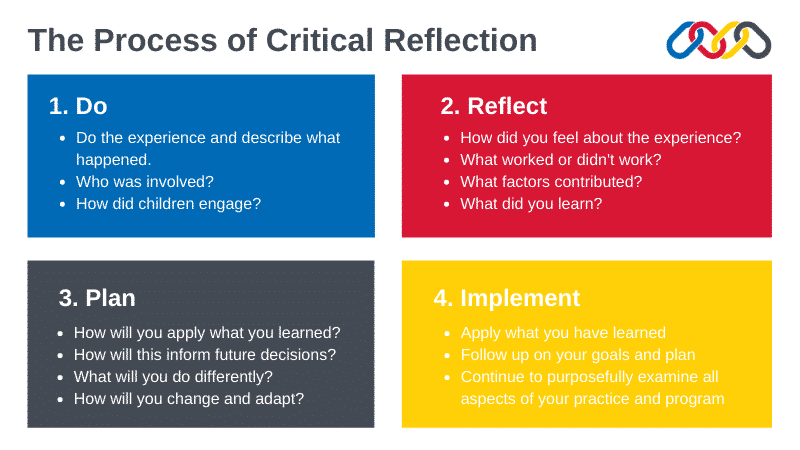
At Montessori Academy, critical reflection in childcare is used to thoughtfully examine teaching practices, learning environments, and educator decisions to ensure children receive the best possible outcomes. Critical reflection is a cornerstone of high-quality early childhood education and care. Through regular, intentional reflection, educators strengthen professional practice, deepen learning, and align their work with the Early Years Learning Framework (EYLF) and the National Quality Framework (NQF).
As an established early learning provider, Montessori Academy embeds critical reflection across daily practice to support continuous improvement and meaningful learning experiences for every child. Learn more about our approach to early learning at Montessori Academy.
What is critical reflection in childcare?
Critical reflection in childcare is a deliberate and ongoing process where educators analyse their experiences, question assumptions, consider multiple perspectives, and evaluate the impact of their practices on children’s learning and wellbeing. It goes way beyond simply thinking about what happened during the day.
Within early childhood settings, critical reflection involves:
- Examining personal beliefs, values, and biases
- Reflecting on children’s learning, development, and engagement
- Considering feedback from colleagues, families, and children
- Using theory, research, and frameworks such as the EYLF to inform practice
The EYLF emphasises critical reflection as a professional responsibility, encouraging educators to continuously improve and adapt their practices to meet the diverse needs of children. If you would like to explore the framework in more detail, read our overview of the Early Years Learning Framework (EYLF).
How do educators implement critical reflection?
Educators implement critical reflection in childcare through structured and informal approaches that are embedded into everyday practice. These may include:
- Daily or weekly reflection discussions with colleagues
- Maintaining a reflection journal or personal reflection notes
- Reviewing learning documentation and observations
- Participating in team meetings focused on reflective practice
- Using critical reflection models to guide thinking and discussion
Reflection may occur individually or collaboratively. Personal reflection allows educators to consider their own teaching approaches, while team reflection supports shared learning and consistent practice across the service.
Daily reflection might involve jotting brief observations and thoughts after an activity, while weekly reflection could be more in-depth, discussing program planning or reviewing children’s learning documentation. Using a combination ensures both immediate responsiveness and longer-term professional growth.
Why is critical reflection important?
Critical reflection is important because it directly influences the quality of education and care provided to children. Through reflective practice, educators can:
- Identify what is working well and what needs improvement
- Respond more effectively to children’s interests and learning needs
- Strengthen intentional teaching strategies
- Ensure practices remain inclusive, equitable, and culturally responsive
Without critical reflection, practice can become routine and static. Reflection ensures that learning environments remain dynamic, responsive, and aligned with best practice principles. It also supports compliance with professional standards and reinforces a culture of continuous improvement.
What makes for meaningful critical reflection?
Meaningful critical reflection is purposeful, honest, and informed. It requires educators to move beyond surface-level observations and actively engage with why practices are used, how decisions are made, and what impact these choices have on children’s learning and development.
Rather than simply recording what occurred, meaningful critical reflection focuses on interpretation and evaluation. Educators consider what the experience reveals about children’s interests, strengths, identities, and learning dispositions, as well as how the learning environment and teaching strategies contributed to these outcomes.
Key characteristics of meaningful critical reflection include:
- Action-oriented outcomes: Reflection leads to changes in practice, environment, or planning, rather than ending at discussion alone.
- Intentionality: Reflection is planned and aligned with clear learning goals or quality improvement priorities.
- Depth: Educators explore underlying reasons, not just outcomes or behaviours.
- Evidence-based thinking: Reflection is informed by observations, learning documentation, professional knowledge, and relevant research.
- Multiple perspectives: Input from colleagues, families, and children is valued and respected.
Using critical reflection models can help educators structure this process. Models such as Gibbs’ Reflective Cycle or the “What? So what? Now what?” approach guide educators from description to analysis and informed action. These models encourage educators to reflect on feelings, evaluate effectiveness, identify learning, and plan future improvements.
Meaningful critical reflection also requires a supportive workplace culture. When services encourage open dialogue, professional trust, and collaborative learning, educators are more likely to engage deeply in reflection and use it as a tool for continuous improvement rather than compliance alone. This is evident at Castle Hill Montessori Academy, where placement student KaYi.K. reflected on her two-year experience, noting that “the staff and the director are incredibly supportive, kind, professional, and always willing to listen,” and that she was given “many opportunities to learn, grow, and implement experiences with their support.” Such environments empower educators and students to reflect honestly on practice, strengthening outcomes for children, families, and the wider learning community.
Engaging in reflection at multiple levels—daily, weekly, and program-wide—ensures educators are responsive in the moment while also fostering broader insights that improve long-term educational quality.
Questions to Promote Critical Reflection
As part of effective reflective practice, educators use intentional questions to guide thinking and discussion. These questions may be explored through daily reflection, weekly meetings, or within a reflection journal. Examples include:
- What did children learn today, and how do we know?
- Which teaching strategies were most effective, and why?
- How did our learning environment support or limit children’s engagement?
- Were all children included and supported in their learning?
- What assumptions did we make, and how might these influence our practice?
- What could we do differently to enhance learning outcomes?
Using reflective questions consistently encourages deeper learning, supports professional growth, and strengthens program planning. These questions also help link practice with the EYLF learning outcomes and quality standards.
Why do educators engage in critical reflection: The benefits
Educators engage in critical reflection because it benefits both professional practice and children’s learning experiences. The key benefits include:
- Improved learning outcomes: Reflective educators adapt programs to better meet children’s interests, strengths, and needs.
- Professional growth: Ongoing reflection supports skill development, confidence, and reflective thinking.
- Stronger teamwork: Shared reflection builds collaboration, consistency, and mutual respect among educators.
- Quality improvement: Reflection supports compliance with the National Quality Framework and continuous quality improvement processes.
- Enhanced relationships: Reflective practice strengthens partnerships with families through open communication and shared understanding.
- Informed decision-making: Reflection encourages educators to base actions on evidence, observation, and theory rather than habit.
Critical reflection also supports accountability, ensuring that decisions are thoughtful, transparent, and aligned with regulatory and ethical responsibilities. By integrating reflection into daily, weekly, and program-level routines, educators develop a professional culture focused on growth and high-quality care.
Critical reflection examples
A critical reflection example in childcare demonstrates how reflective thinking leads to intentional and informed change. These examples may be documented in a reflection journal, discussed during team meetings, or included in program planning and assessment.
Example 1: Adapting group learning experiences
An educator notices that children appear disengaged during extended group times. Through critical reflection, the educator considers children’s developmental stages or Montessori sensitive periods, attention spans, and interests. After discussing observations with colleagues and reviewing EYLF principles, the educator shortens group sessions, introduces more child-led discussions, and incorporates movement and choice. Ongoing reflection shows improved engagement, participation, and learning outcomes.
Example 2: Reflecting on the learning environment
During weekly reflection, educators identify that certain learning areas are rarely used. By critically reflecting on layout, accessibility, and materials, educators reorganise the environment to better support exploration and independence. Subsequent observations indicate increased child engagement and deeper learning.
Example 3: Inclusive practice and equity
An educator reflects on whether all children are equally represented in learning experiences and resources. Through critical reflection and discussion with colleagues and families, the service updates materials to better reflect children’s cultures, languages, and identities. This leads to stronger relationships and a more inclusive learning environment.
Example 4: Daily reflection for immediate responsiveness
Educators may use short daily reflection notes to evaluate how an activity was received by children. For instance, if a painting activity sparks interest in storytelling, the educator may plan follow-up experiences that extend literacy and creative expression. These daily reflections support dynamic and responsive teaching.
These examples highlight how critical reflection supports intentional teaching, responsive environments, and continuous quality improvement.
Frequently Asked Questions (FAQs)
What is the difference between reflection and critical reflection in childcare?
Reflection involves educators thinking intentionally about their own and others’ practices with particular aims or goals in mind. It often focuses on describing what happened and considering whether an activity or interaction was effective.
Critical reflection in childcare goes a step further. It is a meaning-making process that requires a deeper level of thinking, analysis, and evaluation. Educators question assumptions, consider multiple perspectives, and examine how their beliefs, decisions, and practices influence children’s learning, development, and wellbeing. Critical reflection is therefore more analytical and action-oriented than reflection alone.
Why do early childhood educators use critical reflection?
Early childhood educators use critical reflection to improve the quality of education and care they provide. By carefully evaluating the outcomes of their actions, educators can identify strengths, recognise areas for improvement, and make informed changes to their practice.
Critical reflection helps educators refine educational methods, strengthen intentional teaching, and better meet the diverse needs of the children in their care. It also supports professional accountability and continuous improvement within early learning settings.
How often should critical reflection occur in childcare settings?
Critical reflection should be an ongoing process rather than a one-off activity. Educators may engage in daily reflection through brief notes or discussions, weekly reflection during team meetings or planning sessions, and more in-depth reflection as part of program evaluations and quality improvement planning.
What tools can educators use to support critical reflection?
Educators may use a range of tools to support critical reflection, including reflection journals, observation records, learning documentation, reflective questions, and critical reflection models. Collaborative discussions with colleagues and feedback from families also play an important role in strengthening reflective practice.
How does critical reflection connect with the EYLF and NQS?
Critical reflection ensures that educators’ practice aligns with the Early Years Learning Framework and National Quality Standard requirements. It enables programs to meet learning outcomes, assess children’s progress, and implement ongoing improvements, contributing to high-quality early childhood education and care.
For more information, educators can refer to the ACECQA guidance on critical reflection.
How Montessori Academy approaches critical reflection
At Montessori Academy, critical reflection is embedded into everyday practice as a shared professional responsibility across all levels of the service. Educators engage in personal and collaborative reflection daily, weekly, and as part of long-term program planning, using tools such as reflection journals, detailed observation records, team discussions, peer reviews, and structured planning processes. This reflective practice informs curriculum decisions, enhances teaching strategies, supports continuous quality improvement, and ensures full alignment with the EYLF and National Quality Standard.
Our approach to critical reflection in childcare is purposeful, meaningful, and action-focused. Educators are encouraged to question assumptions, explore alternative strategies, and critically evaluate the impact of their practice on children’s learning and wellbeing. By continuously learning, refining practice, and documenting insights, Montessori Academy fosters a culture of professional growth, promotes collaborative problem-solving, and ensures that educational programs are dynamic, responsive, and tailored to support every child’s unique learning journey. Reflection is therefore not a single task but an integral part of daily life, professional development, and long-term program success.